|

|
|
|

|
|
GROVE /
RASCH MUSIC EDUCATION SYSTEMS ELECTRONIC
NEWSLETTER
No. 4 - April 15th
1998 | |
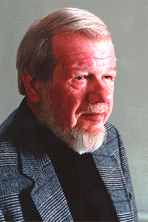 |
A NOTE
FROM DICK
GROVE
|
This month’s articles cover some areas I hope you will
find interesting and informative. In our April issue we will be
talking about ‘counting
off a band or group, and I will be
explaining my concept of ‘Chord Families’ Next month we will be
giving details on an extensive Latin American tour of clinics and
concerts by Dana Rasch. Very exciting!
We would also
appreciate your comments on our MUSIC NOTES articles and suggested
topics you would like us to write about. In the
meantime,
enjoy!
Musically -
Dick Grove |
|

|
|
COUNTING OFF A
BAND
by Dick Grove
When you play with other musicians you play in
‘tempo’, to a prescribed pulse. Someone in the band sets that tempo.
This article is to give you some information and assistance in how
to think about communicating a tempo so that each member of the band
can get the pulse and begin playing together.
You may already
have had occasion to do the very thing I am discussing. However,
there are many aspects to the subject, and perhaps we can shed some
light on some of the less obvious aspects of this technique.
First of all, how do you know the right tempo? You could figure
out the perfect tempo, find that tempo with a metronome, and then
everytime you are ready to play, refer to that metronome to give
yourself the tempo so that you can in turn, communicate that tempo
to the players. This approach might work in a recording situation
(with no audience), but as it takes you time to do it and is not
practical on the bandstand in front of an audience.
Instead,
most musicians do an ‘ear’ tempo. This means you sing a portion of
the music in your head, and from hearing it in your head, you
determine the pulse for the countoff.
The object of counting off
the tempo is to give the players enough of an indication of the
tempo that they in turn, can hear the tempo in their heads. First,
lets get a sense of what this is all about.
The common denominator of all rhythmic meter is a
two measure unit of time. We will refer to that increment of beats
as a strong measure and a weak measure. A ‘strong’ measure means
that there is a stronger, natural emphasis on that portion of time.
A ‘weak’ measure means that that bar has s lesser emphasis. This is
how a musician ‘feels’ time with their ear and in their body. Music
therefore is a succession of these strong/weak measures throughout
the length of the music.
Within the strong/weak measure, depending on the time
signature (4/4, 3/4, etc.) certain beats are more important than
others, as receiving a stronger emphasis. These are called Primary
Beats. In the more common 4/4 meter, there are 8 beats contained in
the strong/weak unit. Beats 1 and 3 of each measure are called
Primary Beats, while the 2nd and 4th beats are called Secondary
Beats or weak beats. These have less rhythmic emphasis. They are
also referred to as the ‘back beat’.
Every meter has this
Primary and Secondary relationship. The following is a breakdown of
the more commonly found meters as well as some of the less used
‘odd-time’ meters and their Primary Beats.
As an example, using
4/4 meter, we can also make a more specific label for the Primary
and Secondary beats contained in each strong/weak unit by labeling
the beats 1 to 8. with 1 to 4 implying the strong measure and 5 to 8
the weak measure”
| 1X - 2X - 3X - 4X - |
5X - 6X - 7X - 8X |
| Strong bar |
Weak bar
|
METER Primary Beats in Strong/Weak Bars
4/4 1 -
3 - 5 - 8
C (cut time) 1 - 3 - 5 - 8
3/4 1 -
4
6/4 1 - 4 - 7 - 10
6/8 1 - 4 - 7 - 10
9/8 1 -
4 - 7 - 10 - 13 - 16
12/8 1 - 4 - 7 - 10 - 13 - 16 - 19 -
22
5/4 1 - 4 - 6 - 9 or 1 - 3 - 6 - 8
7/4 1 - 4
- 8 - 11 or 1 - 5 - 8 - 12
When giving a tempo to musicians, they need to hear
the strong/weak unit of time to enable them to feel the tempo
correctly and accurately. Remember, they are hearing the tempo
indication only once, and from that one hearing are expected to
‘nail’ the tempo and play for as long as needed.
Tempos also
qualify the countoff from the perspective that the slower the tempo,
they may only require one measure of countoff (the weak measure),
and in very fast tempos they may require four bars countoff
(strong/weak/strong/weak). It is a good idea to tell the band ‘two
measures for nothing’ or ‘one measure for nothing’. This means the
countoff relates to time before the music starts, or the first
strong measure.
Now it is time to communicate the tempo you hear in
your head to the players. There are three accepted approaches to
this problem:
| 1. |
Speaking the numbers of the beats and snapping
your fingers on the secondary or back beats |
| 2. |
Speaking the numbers of the beats and clapping
on the secondary or back beats |
| 3. |
Speaking the numbers only (should be short and
‘clipped’ speaking) |
|
|
The normal words spoken are: (using 4/4 as an
example)
1 - 3 = 1 2 3 4
Strong bar Weak bar
In 3/4
time:
1 - 1 2 3
Strong bar Weak bar
In a fast Jazz
Waltz:
1 - 1 - 1 - 1 2 3
Strong bar Weak
bar Strong bar Weak bar
Many song start with what are called ‘pickups’.
These are melody notes that start before 1X of the strong measure.
There can be 1, 2, 3, 4, 5, 6, 7 or even 8 pickup notes before the
first measure of the song or introduction. When this is the case, it
affects how you count off the tempo. Most pickups will be contained
in the measure before the song.
Pickups can start:
1.
after 7X of the measure before bar 1 or the first strong
measure
2. on 7X of the measure before bar 1 or the first strong
measure
3. after 5X of the measure before bar 1 or the first
strong measure
4. on 5X of the measure before bar 1 or the first
strong measure
When this situation arises, the countoff is
handled as follows:
1. 1 - 3 = 1 2 3 -
Strong bar Weak
bar
2. 1 - 3 = 1 2 - -
Strong bar Weak bar
3. 1 2 3
4 1 - - -
Strong bar Weak bar
4. 1 2 3 4 = = - -
Strong
bar Weak bar
| OTHER WAYS TO
START THE
TEMPO |
If you are a player that starts the tempo, you can
give the tempo to the band by playing in tempo. Once they hear you,
they will know the tempo. For ballads, you can simply play a series
of pickup notes in tempo, and set the pulse in that manner. Most
will nod their head on 1X.
In moderately slow to fast
tempos, you can play two bars as a vamp or groove feel, and then the
band enters after hearing your two bars one time.
It is also common and musical to conduct with your
hands to communicate the pulse, or combine speaking and conducting
(instead of snapping fingers or clapping). The art of conducting is
a special discipline which takes training and practice over a long
period of time. The suggestions in this article are focused more on
those of you who may have to count off the band or group but do not
have any conducting experience. We have talked about non-conducting
ways of getting the job done in more of a live- performance or
rehearsal situation.
It is a good idea to practice counting off a tempo
in front of a mirror and to practice singing a portion of the song
in your head to get the correct pulse, then see if you can count off
the tempo at the pulse you think it should be.
This
particular responsibility is very important in live performance, as
the a band or group has to be playing in the right pulse, and must
start together. The more confident you are in counting the
tempo off, the less chance there is for an incorrect tempo or the
band members misinterpreting your message!
I hope that if one
day you are required to do this ‘leading the band’ responsibility,
that these tips will help you be successful!
Dick
Grove
|
|
|
|
USING TRIADS FOR
IMPROVISATION
by Dana Rasch
|
 |
| An exercise to work on that can
help you develop your improvisational skills is restricting yourself
to using triads only.Triads are strong shapes the major triad being
the strongest of the 4 different types and can be used quite
effectively in improvisation. Obviously there are many ways to
restrict yourself when improvising, for instance lines made up of
the 3rds and 7ths of chords, melodic sequences, targeting chord
tones, or using only pentatonic etc..... Being guitarists we can
also create other restrictions that are unique to our instrument,
such as playing linearly on only one string or, using 2 or 3 strings
but not moving out of position more than one fret.
Triads are just another approach that can be very helpful to your
single line playing,this is one reason that I suggest to all
students to nail down their ability to systematically invert all
4 triads in all keys all over the neck.As you will
see, having that ability will bring a new dimension not only to your
comping (as discussed in previous articles) but to your improvising
as well.
The reason I bring up the idea of restrictions is that they have
a tendency to force us to develop our rhythmic phrasing. This is an
extremely important aspect of improvisation that can sometimes be
missed by students of guitar who, can find themselves in a nasty
cycle of soloing with their favorite scale source using 16th notes
at 5,000,000 = a quarter note.
You can hear a triadic approach with many great guitarists in all
styles of music.An obvious technique that uses triads and has been
around in Rock and Fusion styles for quite a while now is "sweep
picking". Though sweep picking is effective it is in no way
necessary in order to create great melodic ideas using triads.
Many guitarists use what are called "alternating triads".
Alternating triads are 2 major triads usually a whole step apart,
for example: The alternating triads for C major 13 #1 1 would be C
and D major. The alternating triads for Gminl1 would be Bb and C
major.Again,you can find alternating triads for every chord type
including all the altered chord types (they are most effective on
altered chords). The alternating triads for A+7(b9 b5) would be Eb
and F major. This is certainly one aspect of triads you should be
aware of for all chord families.
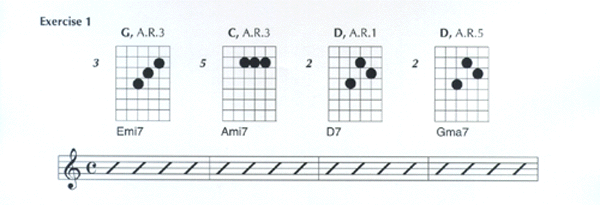
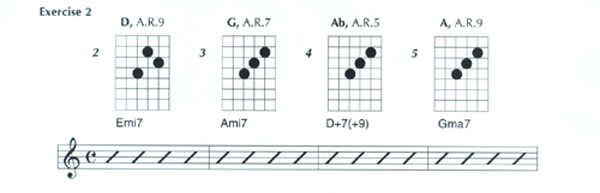
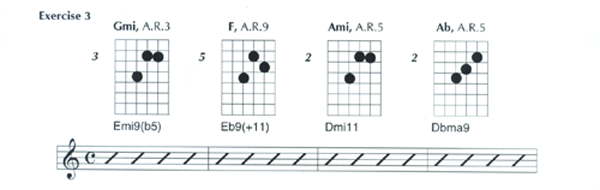
Another idea is using "Assumed Roots".As discussed previously
triads not only work as chords unto themselves but can be thought of
as upper extensions of larger chord forms.Each interior triad of a
larger chord form is called an Assumed Root.
Example 1
In example #1, Emi would be the Assumed Root 3 of
Cmajor7, it being the resulting triad built from the 3rd
degree of the chord. We 'assume' that the 3rd of the
Cma7 chord is now the root of an Emi triad. The
Assumed Root 5 of that same chord would be a Gma triad. The
A.R.7 is Bmi, the A.R.9 is a Dma triad, and the A.R.
13 or 6 would be Ami. This concept is from the Chord Family
concept discussed in another article in this months MUSIC NOTES by
Dick Grove.
Try laying these chord progressions down on tape, then improvise
over them using the triads given. As you become more comfortable,
expand to other inversions of the same triads, then try different
Assumed roots. Start listening to these triad shapes against each
chord type and recognize the impression each chord type creates
|
|
|
|
|
THE CHORD FAMILY
CONCEPT
by Dick Grove
One of the measures of a good teacher and a good
teaching program is that the subject of music, with all of its
aspects, will deal with the basic premises from which the
music is created.
Without the understanding of these basic
axioms and principles, all that is left is an endless stream of
details to somehow be memorized, absorbed and applied to
contemporary music.
Most teachers do not understand these
basic ideas themselves, much less teach from them! You can talk
about music forever and still not have the ability to work from the
standpoint of these basic, essential principles.
This is why
our teaching programs get the results we say they will! They explain
and teach from this way of thinking. In the process, the student
saves literally, years of frustrating work.
We are talking
in this article, about one of the concepts I have developed over the
years that deal with many important areas of creating music, either
as a performer or as a composer/arranger/writer. It is called CHORD
FAMILIES.
I would like to explain the essence of this
concept, how it can help you, and how it organizes the harmonic
vocabulary of contemporary music.
The smallest chord form is the triad, and the
largest tonal chord form will have 8 different notes. In between
there are chords with 4, 5, 6 and 7 different tones. It is a
staggering array of combinations of notes that are possible in 15
different keys and enharmonic spellings!
In total, there are
around 120 different chord forms (3-part to 8-part) that make up our
chord symbol vocabulary within each key center. That adds up to 1800
different chord symbols when you have them in 15 keys!!!
It is
important to understand that knowing chord symbols is only the
gateway to learning how to make music with them. To further
underscore the ‘impossible dream’ we are discussing is the fact that
a good musician actually knows what all of these forms sound like -
yes - his or her ear is developed to the point that they can look at
the chord symbol and hear the sound of the particular combination of
tones. A remarkable ability to say the least.
On the other
side of the coin is the point that knowing this information and
having the ability to hear them is a subjective goal - some forms
are rarely used, and certain of our contemporary styles favor many
of the simpler, less complicated and involved forms. So the
point is that this is not a ‘test’ that you have to pass to be a
functioning musician. What we all strive for is to be comfortable
with the chord symbols we need to know to play or write the kind of
music we desire to create.
Having said of all this, it is
also obvious that to know even half of the different chord forms, in
all keys and to be able to hear them is still a imposing
challenge.
Lets talk a minute about how most of us learn our
chords. Many learn via their instrument, gaining an understanding
from the visual ‘look’ on their keyboard or fretboard. Some buy the
book and start memorizing, playing and gradually learning more and
more, with the book as a backup if they get stuck. This amounts to
eventually playing long enough that the majority of chords are in a
comfort zone of accessibility.
There are many who can’t tell
you how they learned all of this - they did it over a period of time
anyway they could! The end of this conversation comes down to
one final conclusion. There needs to be an approach that not only
covers the gamut of possible chord forms, but trains your ear to
hear them, and most important, shows you how the forms are actually
used in making real music (not exercises and drills). When this can
be accomplished in an organized, straightforward way, you can save
yourself years and start operating with confidence and
authority.
This concept was first conceived in 1970 as I was
in the process of writing a book called “Arranging Concepts” This
was designed as a text to train musicians to become arrangers and
orchestrators for big bands and groups.
I needed some
organized way to codify all possible chord forms and to present them
as an efficient method of reference to the writing process. When I
started my college in Los Angeles in 1973, I then used this approach
in Modern Harmony classes, and applied to performance in the areas
of improvisation, chord melody, comping and understanding different
contemporary musical styles.
Many of the thousands who have
studied this approach tell me that they feel it provided one of the
most significant learning advances for them. What it accomplished
was to make the goal accessible and possible in a relatively short
amount of time.
Here is the concept - in a nutshell:
| 1. |
All chords function in either a major tonality
or a minor tonality. |
| 2. |
All chords function as either resting chords or
active chords in a major or minor tonality. |
| 3. |
Chord Families are the grouping of all chords
into categories of resting and active chords in major or minor
tonalities. |
| 4. |
All chord forms (from 3-part to 7 or 8-part) are
interchangeable within that Chord Family. This is how style is
applied to the method. |
| 5. |
All possible chords are organized into nine
Chord Families in this approach, three in major and six in
minor. |
All Chord Families are presented so that you
learn:
| a. |
the function of each group of chords in major
or minor, active or resting |
| b. |
the scale source of each chord form |
| c. |
the formula from which you can build any form
from any note thereby learning them in
all keys |
| d. |
the solfeg eartraining function of each
Family, which gives you the technique
of being able to hear these chords |
| e. |
the grouping of the restricted tones of each
Family into 3, 4, 5 or 6 part forms,which then adapts the form
to the instruments you play, or the instruments you might
write for. |
| f. |
special triadic relationships such as
Alternating triads |
| g. |
how to identify Chord Families for harmonic
dictation |
| h. |
the definitive tones of each form, which
becomes the basis for
improvising through chord
changes. |
This approach makes up much of our musicianship course
called ‘See It - Hear It / Hear It = Play It’ Parts 1 and 2.
Starting with Chapter Ten of Part 1, and continuing through Chapter
19 of Part 2, each lesson covers a Chord Family or variation,
resulting in a total understanding and ability to utilize the entire
vocabulary in the music of your choice.
It helps not only from a performance standpoint, but
for writing down the proper symbols, for harmonizing melodies, etc.
Each Video Lesson of a chapter includes explanations, musical
demonstrations and an added understanding of how all of this works,
over and above what is contained in the text and
workbooks.
One thing I know is that it is really possible to
learn this important aspect of music, and in a real way - meaning to
be able to hear the sounds. Just mechanically being able to spell
the chords is only one step in the process.
I hope this
explanation is interesting to you, and I would ask you to try to
objectively appraise your own understanding and abilities in these
areas.
If you feel not too sure of yourself, or know your
chords but do not have the eartraining to hear them, or feel limited
in your ability to use them, then you might wish to seriously
consider these unique courses. Give me a call at (800)994-7683 and
we can talk more about chords and you!
Dick Grove
|
|
|
|
GET
INVOLVED
SEND IN YOUR SUGGESTIONS FOR A
‘MUSIC NOTES’
LESSON!
Give us your
ideas for a lesson you would like to see in Music Notes. This
can be in the areas of: (one suggestion
per)
a. Guitar
b. Improvisation
c. Harmony
d.
Composition
e. Keyboard
f. Harmonizing
melodies
g. Eartraining
h. Arranging
We will
review suggestions and choose a topic we find appeals to the
largest number of people.
NOTE: Please give us your
name, Email address and phone number
CALL
(800)994-7683 or Email dana@beyondchops.com NOW
TO GET INVOLVED WITH MUSIC NOTES OR JUST DROP US A LINE TO
FIND OUT ABOUT ANY OR OUR
COURSES |
|
|
We would appreciate your comments on
this and all or our MUSIC NOTES Electronic Newsletters!
Drop us an Email to: Editor
MUSIC NOTES
dana@beyondchops.com | |
Enjoy!
Dick Grove and Dana Rasch |