|
HEARING QUARTER NOTE TRIPLETS
by Dick Grove
I have noticed through the years that I have taught music
to 1000's of students, that the execution and understanding of the
quarter note triplet is often a problem. If you are already a
excellent reader, then this is a bit obvious to you, but if you have
trouble sightreading these rhythmic figures, it is time you overcame
this obstacle!
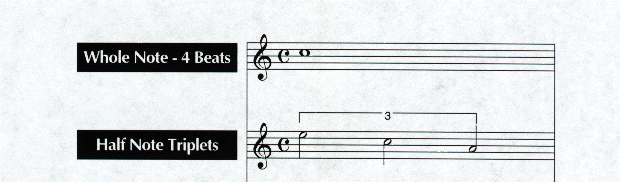
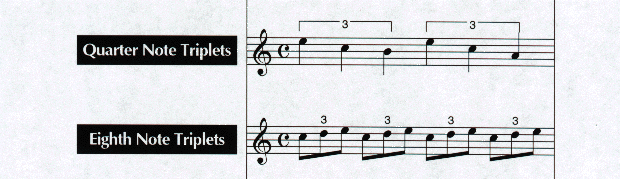
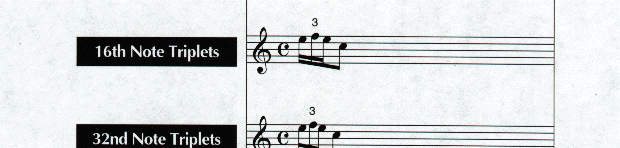
The normal definition of a triplet figure is to execute three
attacks in the time normally allotted to two attacks. Therefore it
is possible to find:
| a. |
whole note triplets (very seldom found, and
only in super-fast cut-time tempos) |
| b. |
half note triplets (again, rare and only in
fast cut-time Broadway type tempos) |
| c. |
quarter note triplets (subject of this
article) |
| d. |
eighth note triplets (the most common of
triplet figures) |
| e. |
sixteenth note triplets (found in
embellishments of melodies) |
| f. |
thirty-second note triplets (rare - found in
slow ballads) |
| g. |
any of the above with rests substituted for
notes (complicates the triplet) |
EXAMPLE 1
| THE PROBLEM WITH HEARING
TRIPLETS |
Regardless of the specific triplet figure that you might be
expected to play, the problem that you must overcome is being able
to ‘hear’ the point of attack of the 2nd and 3rd notes in the
triplet figure. This is because the timing does not coincide with
the up-beats and down-beats of the meter of the
music.
Whereas with 8th-note triplets you are to subdivide a
quarter note into three attacks one-and-ee, two-and-ee, etc, the
situation is compounded with the quarter note triplet because the
time allotted to the figure is suspended over two beats instead of
only one. With the half note triplet (three in the time of four
beats) the suspension is even longer, and with whole note triplets,
it is suspended over eight beats.
The longer the suspension,
the more difficult to execute or hear the triplet.
|
SUPERIMPOSING 3 AGAINST
2 |
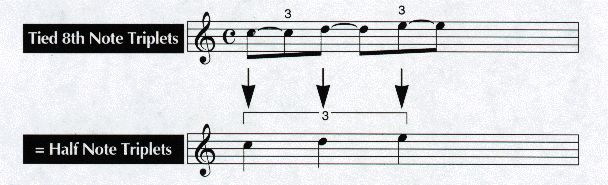
The quarter note triplet is like two beats of
8th note triplets, with each consecutive two attacks
tied.
Example 2
The simple fact of the problem is that you can’t
really ‘count in your head’ when trying to execute this rhythm! The
only way it can be done is to literally ‘hear’ the rhythm as a
rhythmic melody, and in so doing, be able to ‘adjust’ the timing to
fit the specific tempo you are playing in at the time. This could
range from a slow, ballad tempo to a fast, brisk tempo. Think of
this process like being able to sing the melody of a song in a slow,
ballad tempo all the way up to the bright, faster tempo. If you
could sing the melody of the song in these tempos, you are actually
adjusting the melodic rhythm of the song you are singing to ‘fit the
tempo’. We do the same thing when singing, playing and hearing the
quarter note triplet.
Try beating your hands on your legs,
with your left hand tapping quarter notes (1-2-3-4) while your right
hand tries to tap three quarter note triplets in the time of two
taps with your left hand. It is a bit difficult to do! And there
needs to be a better way to approach the problem!
The trick to hearing the common quarter note triplet
(suspended over two beats) is to feel it like three attacks played
over one beat instead of two. We can do that if we feel the Primary
beats of 4/4, common or cut-time. The 1st and 3rd beats of the
measure are to be felt like you would feel beats 1 and 2, 2 and 3,
etc. You basically are ‘hearing’ a measure of 3/4 time (a waltz)
with each 3 beats of a waltz starting on a primary beat of the 4/4
meter.
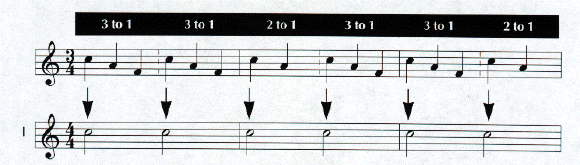
Example 3
Use this example as a practice exercise. First, tap the lower
stave with the half notes hitting on the primary beats of each
measure. Feel each attack as the first beat of a 3/4 waltz. With
your right hand (singing as you do it), tap three attacks, evenly
spaced like a waltz, during each left hand attack.
As you do
the exercise you will notice that when you get to the 3rd bar, the
top stave now contains only two attacks, which subdivides the half
note evenly, like quarter notes in the 4/4 meter. The 4th bar then
goes back to a waltz feel as does the 5th bar. The 6th bar now
contains only one attack in between the half notes, like bar 3. This
gives you practice going back and forth between quarter note
triplets (with the 3/4 feel) and quarter notes (with the 4/4 feel).
When you can repeat this exercise three or four times with out
hesitation or getting off, you have made good initial headway on
mastering the concept of quarter note triplets.!
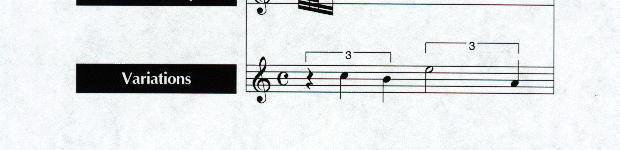
Typical variations of quarter note triplet rhythms
will be the substitution of rests for attacks, and the tieing of two
of the three quarter notes to each other. Here are the most commonly
found variations:
| a. |
the first quarter note as a rest, followed by
two quarter notes |
| b. |
tieing the first two quarter notes together,
followed by the third quarter note
|
Quarter notes are played full value to achieve the
broadest articulation. On occasion this rhythm will be played with
short attacks, but this is usually only found in fanfares and other
production-like settings.
| OTHER ODD NUMBERED
RHYTHMS |
When playing music in a 3/4 meter you will
occasionally find a rhythm that superimposes four quarter notes in
the time of three quarter notes.
The approach for this superimposition is similar to
the half note triplet but in this case you must feel four even
quarter notes between the first beat of each measure of the 3/4
meter.
Other unusual irregular rhythms can be found in which
rhythms are superimposed:
| a. |
5 against 1 / 5 against 2 / 5 against 4 |
| b. |
7 against 1 / 7 against 2 / 7 against 4 |
| c. |
9 against 1 / 9 against 2 / 9 against 4 |
| d. |
11 against 1 / 11 against 2 / 11 against
4 |
Even numbered rhythms are a different context as
they are only normal groupings of 8th, 16th, 32nd or 64th
notes.
Once you master the quarter note triplet timing,
you have your solution and the ability to execute them in all
situations.
Dick Grove
|
|
In contemporary music, chord symbols are an important code of
communication.There are many musicians who can not read notes, but
are quite adept in reading chord charts (chord symbols only). A
chord symbol is a kind of ‘shorthand’ musicians use to represent
different chord forms used in the harmonization of songs and
compositions. Improvisation is based on chord symbols only, and
contemporary musical styles are represented by the use of chord
symbols sharing the same unique characteristics.
The ground
rules, or ‘grammar’ of chord symbols is quite varied, with a
situation that depending on where and with who you study music,
different rules are found. Many of the theory books on contemporary
music will have drastically contrasting ways of notating chord
symbols. The purpose of this article is to define the standard in
chord symbol terminology so that you can compare your own
understanding to the standard, or if you are in the process of
learning chords, to adapt these solutions for your own
use.
Here is a list of ‘given’ rules that define chord symbol
terminology:
| a. |
capitol letters are always used for
letternames (D, F#, Ab, B, G, etc) |
| b. |
a capitol lettername implies a major triad.
(‘C’ means ‘C’ major triad) |
| c. |
a capitol lettername followed by the number
‘6' implies a major 6th chord (C6, Bb6) |
| d. |
a capitol lettername followed by the number
‘7' denotes a dominant 7th chord (C7, F7) |
| e. |
a plus sign ( + ) means augmented, so a
capitol lettername followed by a + denotes an augmented
triad. (C+, Ab+) |
| f. |
a plus sign after a capitol lettername and
followed by a ‘7' denotes an augmented 7th chord. (C+7, G+7)
It means the 5th of the chord is augmented or raised one
half-step. It does not mean the 7th of the chord is augmented.
You will find symbols reading Caug7 which is a more academic
solution, but the C+7 is quite acceptable. |
| g. |
a º sign (small raised circle) after a
capital lettername denotes a diminished triad (Cº) |
| h. |
a º sign after a capitol lettername and
followed by a ‘7' denotes an diminished 7th chord. (Cº7, Fº7)
It means the 5th of the chord is diminished or lowered one
half-step. The 7th of the chord is also diminished. You will
find symbols reading Cdim7 which is a more academic solution,
but the Cº7 is quite acceptable.
|
| i. |
the extensions (or upper portions) of chords
include the 9th, 11th and 13th. It is possible to
have: |
| 1. |
a b5th, 5th or +5th (also can be written as
#5) |
| 2. |
a b9th, 9th or +9th (also can be written as
#9) |
| 3. |
a 11th or +11th (also can be written as
#11) |
| 4. |
a 13th or b13th |
| 5. |
it is possible to have a double alteration of
the 5th or 9th (+5,b5 /
+9,b9) |
| j. |
unaltered extensions are written following the
lettername (C9, C11, C13) |
| k. |
an extension implies all the chord tones below
that extension |
| 1.
|
a 9th implies there is a 7th, 5th, 3rd and
root |
| 2. |
an 11th implies there is a 9th, 7th, 5th, 3rd
and root |
| 3. |
a 13th implies there is a 11th, 9th, 7th, 5th,
3rd and root |
| 4. |
a C9(13) would mean to play a 13th chord
omitting the 11th |
| l. |
any altered chord tone or extension is written
in parenthesis i.e. C7(b9) , Ami7(b5) |
| m. |
when more than one altered tone is present in
a chord, the highest tone is written on top, followed by the
lower extension below: |
 |
| n. |
double or triple alterations can also be
written horizontally i.e. C7(b13,b9) |
| o. |
selective extensions are indicated in
parenthesis i.e. C(addD) or C(add9) |
| p. |
extensions of diminished 7th chords are
written: |
|

|
| q. |
Major 69 chords are written so that the 9 is
slightly raised from the baseline
(C69) |
Selecting the form of chord symbol is
sometimes determined by the style of music. Most pop,. rock, rhythm
& blues, country, funk etc., will use smaller chord forms of
chords, maintaining a three or four note level of complexity. More
sophisticated styles will utilize all forms up to and including the
13ths and altered versions of chords.
Often, in the case of the
melody providing the 9th or 13th of a chord, you will find the chord
symbol shown in a smaller form, but combined with the melody,
producing the actual chord which could then be a 9th or 13th
chord.
Chord symbols can be made more modern sounding by
adding extensions (such as the different forms of 9th, 11th and
13th) to create a more sophisticated stylistic impression, or by
using basic triads to make the harmony more basic sounding and less
an important factor of the music.
Chords tell a musician
basic information, such as whether the harmony functions as a
diatonic resting chord or active chord. They also specify if the
chord is chromatically altered. Chord symbols are not played
literally. By this we mean the performer takes in the basic
information and then in the process of creating their ‘part’
or musical solution, will interpret the chords to best fit their
specific instrument in context to the orchestral combination of
instruments playing.
Along with
specifying the diatonic and chromatic diatonic and chromatic chord
types, information regarding how many beats each chord is ‘in force’
or to be used is accomplished by using slashes or ‘virgules’ to
denote how many beats is assigned to each chord. The slashes, (
/ / / / ) will represent each beat of the 4/.4,
3/4 or specific meter of the music. The conventional meaning of the
slashes is not to literally play even quarter notes (although it is
often interpreted that way in ‘rhythm guitar’ playing), but rather
to allow the player on guitar, keyboards or improvising to devise
their own rhythmic sentences. In this ‘common’ notation of rhythm,
the player plays rhythms that identify the musical style, tempo or
feeling desired. A lead sheet is not an arrangement. It is simply a
guide part that the player converts into his finished rendition of
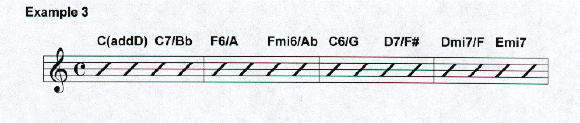
the music. Example 1 demonstrates slashes used to represent straight
‘time, while Example 2 illustrates rhythmic slashes dictating the
precise rhythm that the play would play with the chords. They are
typical of concerted or ensemble rhythms found when the entire group
or band play the same rhythm.
In this sense all components are looked at in a very
flexible manner. For instance:
| a. |
the melody can be rhythmically re-phrased,
embellished and improvised |
| b. |
the chord symbols can be made larger or
smaller |
| c. |
the rhythmic slashes are ignored from a
literal standpoint and instead, used as a foundation for
rhythmically establishing the style of music, relative to the
tempo. Each player also contributes the best rhythms in
relationship to his
instrument. |
As chord symbols
per se do not communicate an ‘arrangement’ for the players, we have
just discussed how each player fashions his own part from the guide
part instructions that the chord symbols and rhythmic slashes tell
him or her. There are however, specialized chord symbols that give
the player more specific information resulting in the lead sheet
beginning to control how the player interprets the
symbols.
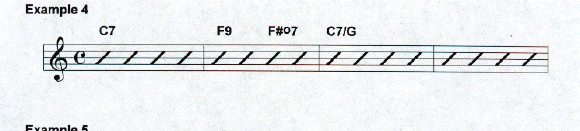
The most commonly found specialized variation is the
use of chord inversions. They tell the player to play the chord as
usual, but to place a given note in the lowest voice on guitar or
keyboards. They also instruct a bass player as to the specific note
of the chord to play.
As a chord inversion means to invert
the tones of a chord into a different permutation or position, the
notation of a chord inversion is important to understand. It is also
critical to understand why a chord inversion would be used, as
opposed to defaulting to the obvious root in the bottom voice at all
times.
To communicate to the player the note of the chord to
play in the lowest voice, write the basic chord symbol as usual,
followed by a diagonal slash ( / ) and the inversion tone desired (
C/E ). On occasion you will also find it written C/3. One version
writes the specific tone, the other version writes the chord
function (3, 5, 7).
Inversions are limited to the 3rd, 5th or
7th of a chord, as the higher extensions would sound like a
fundamental part of the chord resulting in making the voicing sound
like a incorrect chord. Any voice placed in a lower voice will tend
to sound like a fundamental part of a chord.
The reason to
utilize inversions is to control the bass voice to achieve a
horizontal, melodic sounding voice. The result is that the outside
voices (highest and lowest) create two horizontal melodies moving
against each other. This makes a more sophisticated impression and
sounds more musical than always using roots in the lowest voice.
Inversions are more typically used on ballads and slower tempos. The
following examples illustrate the typical use of inversions in
different contemporary styles.
Another notation
device used to better ‘control’ the interpretation of the chord
symbols is called a polychord. As ‘poly’ means more than one, the
definition of a polychord is to superimpose one chord on top of
another. The upper structure is usually a triad shape, however it
can also be a 4-part chord form. The correct chord symbol for this
relationship is to place a chord symbol over a horizontal line,
denoting to play the upper chord over the lower chord.
This symbol
instructs a player to play the upper triad shape over the lower
chord symbol. The lower is the basic chord. Any chord can be turned
into a polychord, thus there is another entire system of polychord
symbols that are alternatives to all the conventional symbols. It is
an involved and sophisticated harmonic creation and is typical of
jazz, standards, fusion, jazz/fusion and more compositional styles
of contemporary music.
In the orchestration of a polychord,
a keyboardist would play the upper shape in their right hand and
some interpretation of the lower chord in their left hand. A
guitarist would play the upper triad, leaving the lower chord to be
played or implied by the bass part, the keyboards, etc. The
guitarist can also play the upper triad shape plus one or perhaps
two of the tones from the lower chord. In orchestral music you hear
polychordal combinations where in the trumpets play the upper shape,
the low brass of trombones, French Horn play the lower chord,
etc.
| MODAL ALTERNATING TRIAD
SYMBOLS |
Another
specialized type of chord symbol is found in contemporary music that
is based on Modal harmony. The most prevalent type of modal harmony
is called ‘static modes’. This means that a song or composition is
based on many measures of one mode, and although it may shift to
a new mode in a new key, it is unlike conventional chord
symbols. It is more like modal scales changing from one to
another.
When playing or arranging music in static modes, a
harmonic definition is required. That definition is achieved by
using the IV - V triads of the major scale from which the mode is
derived. As a case in point, a D Dorian mode is based on moving from
the 2nd tone of a Cmajor scale ( D )
up an octave to the next
‘D’. As the mode is derived from the tones of the Cmajor scale, that
is the source and can be referred to as the Relative Major of D
Dorian. The IV - V triads of the C major scale are F and G major
triads. Any tone of these two triads can be placed on top as the
melody by inverting the triads to position the triad in this manner.
As there are three possible melody notes from each triad, the
combination of the two triads will therefore harmonize six of the
seven melody notes of a major scale.
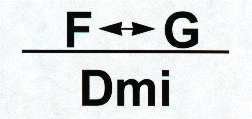
This relationship can be
notated and communicated to players by using a special chord symbol
that shows the IV and V triads placed over a horizontal line. Below
the horizontal line is either the basic I chord of the mode, or the
tonic of the mode. Below are the Modal Alternating Triads for all
the modes based on the ‘C’ major scale.
The dash between the
IV and V triads can be thought of as a double arrow, in that it
represents that you can move from either triad to the other, in an
alternating fashion. If graphically written out, it would look
like:
Take each of the
modal alternating chord symbols shown in Example 7 and play them on
your keyboard or guitar. You will recognize that ‘sound’ as the one
you hear all the time, particularly on current funk recordings as
well as in jazz music. This is how it is notated, and when the
players see this, they ‘do their thing’.
| NOW SOME 'DO'S' AND SOME
'DON'TS' |
Here are some
important guidelines to try to remember when writing chord
symbols:
| a. |
when indicating minor, it is best to write out
mi. Do not use a dash ( ? ) for minor |
| b. |
when indicating major, it is best to write out
Ma or ma Do not use a triangle for major |
| c. |
try to write an uniform size of lettering, and
not too small. Players are looking 2 or 3 feet from the music,
so ‘confidential’ size writing is a real strain! |
| d. |
place a chord symbol directly above the beat
it is attached to. Most chord rhythms change on the primary
beats of a measure. Try to be exact in this placement! |
| e. |
you can often write a composite part for
keyboards and guitar and bass - the same part for all three
instruments when writing a chord chart. They all share the
same information. |
Hope you have found
some useful and perhaps new information in the above, and remember,
one way to make good musical friends is communicating clearly.
Everything gets done better faster, more musically and with more
energy.
Good Luck to
you
Dick Grove
|