|

|
|
|


|
|
GROVE /
RASCH MUSIC EDUCATION SYSTEMS ELECTRONIC
NEWSLETTER
No. 12 - December 15th
1998 | |
 |

A NOTE
FROM DICK
GROVE
|
We are already to Christmas, December 1998! We now
have an entire year of MUSIC NOTES available to you, and we hope
that you have enjoyed our first year of articles and
mini-lessons! I hope that each ‘nook and cranny’ covered has
added one more piece to the musical puzzle and that you are
enlarging your appreciation of how all of this works!
We have
just enjoyed our biggest two months of enrollments since we launched
the ‘School Without Wall’s’ and it is very gratifying to get the
opportunity to work with so many of you all over the
world.
We also invite you to check out our new full page,
4-color ads that will begin to appear in January in both Keyboard
Magazine and Guitar Player. If you feel like it, please give me a
call as I would like to hear your impression of the ads - helps us a
lot to hear some feedback.
Pleliminary plans are underway
with my new dedicated Improvisation course (for all instruments)
that should be available around the middle of 1999, and
hopefully sooner. There will be work books for treble clef
(Concert), bass clef (Concert), Bb instruments and Eb instruments.
It will feature CD’s of examples and plenty of play-along practice
tracks featuring a great quintet with world-class players such as
Jay Daversa on trumpet and Lanny Morgan on Alto Sax, plus rhythm
section of course.
We have extended our sensational discounts
until the end of the year. Check out our End of the Year Newsletter
at: http://www.dickgrove.com/a4b
Here is a timely way to not only get a great discount on course
prices, but you also save off the price increase starting on January
1, 1999.
Enjoy -
Dick Grove
|
|

|
|
IImi7 and IV
CHORDS IN CONTEMPORARY MUSIC
by Dick
Grove
If we were to look at our contemporary musical
styles in a very comprehensive manner, we would realize that in
Western music, all harmony basically functions as either resting
chords (I chords in major and I chords in minor) or active chords.
The subject of active chords is a large one, as it includes mi7th,
dom7, dim7, mi7(b5), +7th chords etc.
Regardless of this
imposing number of chord types and forms, they all boil down to
functioning in a key center as either resting or active. Active
suggests that the impression the chord makes relative to a key, is
that a resolution is required to follow the chord to a natural
conclusion.
The two most common of these active chords,
depending on the style, are the IV major chord and the IImi7 chord
along of course, with the grand-daddy active chord, the dominant
7th, including all of its possible variations of altered tones (such
as altered 9ths, 5ths, 11th and 13th) As the definitive tones
included in the dominant chord tells your ear the momentary key
center you are in, the thinking would be that the IImi7 and IV major
chords that usually precede a dominant chord seem to be an
additional active chord.
| THE RELATION
OF THE IImi7 & IVma CHORDS TO THE
V7 |
These two additional chords however, are
really incomplete forms of the V7. In this context then, we can
realistically consider all chords in progressions, to be either a
form of a I resting chord or a V7 active chord.
What
determines if a chord is active or resting is whether or not the
chord includes resting scale degree tones or active scale degree
tones. The most apparent active scale degree tones are the tones
that move by a half-step in the major scale - i.e. the 7th degree
(TI) resolving to the octave (DO) and the 4th degree (FA)
resolving to the 3rd degree (MI).
As DO and MI are resting
tones (sounding final and not requiring a resolution), the use of
the active leading tones identify and tell our ear that the harmony
is active and some form of a V7. In more basic harmonic styles it is
typical to find the IV - V - I progression while in more
sophisticated styles the typical progression is the IImi7 - V7 - I
chords. The IV triad or the IImi7 4-part chord both include the
tonic of the scale, or DO. This tone is included but the 7th tone.,
TI, is not! The reason being that there is an unacceptable clash
when you hear the TI or 7th tone placed below the tonic or DO. The
use of the IV or IImi7 chords are therefore a way of using DO and
avoiding the clash caused by the use of TI or 7th degree of the
major scale.
It is also common to find the IV triad and IImi7
4-part chord used with the V7 chord (omitting the use of the 3rd of
the V chord, or TI (7th degree of the scale). When written as a
chord symbol, the chord is written” F/G or Dmi7/G. When seen in this
way, it is obvious that the upper structure is the IV major triad in
the key of C major, or the IImi7 in the key of C major. When played
over the root G, you have created a G11th chord, but if played
literally as written, the notes included in the chord symbol will
omit the B of the G7 (the TI or 7th tone of the scale).
This
particular sound is the ‘pop’ or contemporary version of the V
chord, and makes an impression of a suspension caused by the use of
the DO (tonic) and the absence of TI (7th degree).
The
following example demonstrates these
relationships”
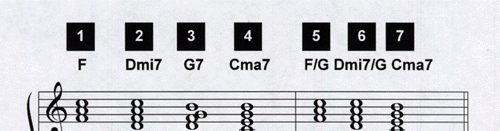
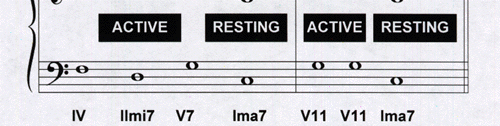
Example 1
| Point 1 - The
active IV major triad in ‘C’ major containing the tonic of the
key(C) or DO |
| Point 2 - The
active IImi7 4-part chord in ‘C’ major containing the tonic of
the key(C) or DO |
| Point 3 - The
active V7 4-part chord in ‘C’ major containing the leading
tone of the key(B) or TI |
| Point 4 - The
resting Ima7 4-part chord in ‘C’ major |
| Point 5 -
The G11active chord omitting the 3rd and 5th of the chord,
leaving a ‘F’ major triad, |
|
with the same tones as the IV major triad in
Point 1 |
| Point 6 -
The G11active chord omitting the 3rd of the chord, leaving a
‘Dmi7’4-part chord, |
|
with the same tones as the IImi7 chord
in Point 2 |
| Point 7 - The
resting Ima7 4-part chord in ‘C’
major |
Try playing all of these examples and combinations
in all keys. Listen to the sound, and realize that if you know your
basic triads and 4-part minor 7th chords, that you have the ability
to add the root of the V chord and create these V11
structures.
Good luck -
Dick Grove
|
|
| THE TRITONE
SUBSTITUTION
By Dick
Grove |
| |
|
WHAT IS IT AND HOW DOES IT
WORK?
One of the more common jazz chord substitutions is
called the tritone substitution. It is based on the interval of the
tritone. A tritone means a distance of three whole steps.
The standard explanation to applying this substitution is to
replace a dominant 7th chord with another dominant 7th chord whose
root is a tritone away.
It is a radical key change as the
number of accidentals in the key change total six - and six is
the
number of half-steps found in the tritone interval. So it
like suddenly changing key from ‘C’ to the key of ‘F#', or from the
key of ‘F’ (one flat) to the key of ‘B’ (five sharps). This extreme
chromatic modulation is very noticeable because of the number of
accidentals and therefore adds a great deal of color to a chord
progression.
We will now discuss how this type of
substitution and key change is possible. To begin, we know that
within a major scale there exists a tritone interval between the 4th
and 7th degrees of the scale. So this unusual interval is a natural
event, and not outside of normal, tonal music.
The next
conclusion is that the two tones of the major scale that create this
tritone interval are the
leading half-steps of the major scale
(TI or the 7th degree which resolves upward to the tonic or DO and
FA or the 4th degree, which resolves downward to the 3rd degree or
MI of the scale). These two leading half-steps (TI and FA) are also
the 3rd and 7th of the V dominant chord.
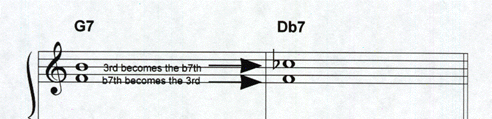
When our tritone
substitution is applied, the new key center is created by the 3rd
and 7th of the given dominant chord trade places. This means that
the 3rd of the chord now functions as the b7th of the new dominant
chord, and the b7th of the chord now will function as the 3rd of the
new dominant chord. The same tone or pitch simply change their
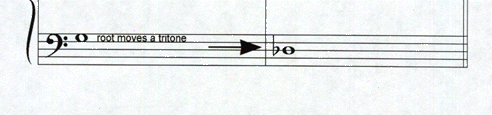
function in a tonality.When this happens, the root of the dominant
chord changes to the tone a tritone or six half-steps
away.
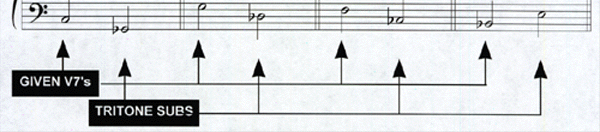
In our next example we will demonstrate how a G7 chord
is substituted by a Db7.
Example 1
ITritone substitutions take the place of a dominant
chord. They are not considered an ‘added’ chord
to a progression,
but rather an option to the written dominant chord.
The
effect of this substitution has two principle impressions. The first
is that when the new root is heard, it brings chromatic color to the
harmonic texture. It adds a bit of a ‘surprise’ to the immediate
context of the music.
The second impression is that the form
of the dominant chord is affected. In general, out of all of the
possible combinations of 5th, 9ths, 11ths and 13ths possible on a
dominant chord, they can be categorized as basically diatonic
sounding or chromatically altered.
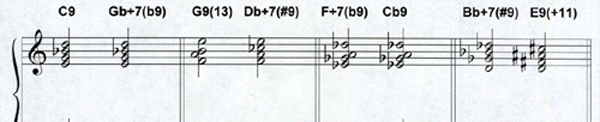
When the tritone
substitution is applied, any given dominant chord that is diatonic
will now sound
altered, and conversely, any altered form of
dominant will now sound diatonic.
Example 2 will illustrate
this change of harmonic character.
Example 2
In the application then of the tritone
substitution (in its simplest procedure), you can play the normal
dominant 7th form on the music or standard progression, and then
change the root only and in effect create the tritone
substitution.
A good exercise to familiarize yourself of all the
tritone possibilities is to play dominant 7ths in all keys, then as
you hold the chord, play the two roots (the root of the chord
followed by the tone a tritone away
Hope you enjoy adding this nice change of chords to
your playing and interpretation of songs.
Have fun
Dick Grove
|
|
We would
appreciate your comments on this and all or our MUSIC NOTES
Electronic Newsletters! Drop us an Email to: Editor MUSIC
NOTES |
Enjoy!
Dick Grove and Dana Rasch |