|

|
|
|

|
|
GROVE /
RASCH MUSIC EDUCATION SYSTEMS ELECTRONIC
NEWSLETTER
No. 2 - February 15th
1998 | |
 |
A NOTE
FROM DICK
GROVE
|
Here we are with the second of our monthly news
letters! We hope you enjoyed the first one and got something from
our articles.
In this months 'MUSIC NOTES' I have an article
on Blues Harmonization which I hope will fill in some areas for you
that will enable you to harmonize your original blues melodies. My
other article has to do with how keys are chosen for instrumental
performance and for singers.
Dana Rasch has an article for
all of you guitarists on chord melody and comping which should give
you some neat ideas that you can work on on your own.
Dana
and I both hope you like our idea of a monthly electronic newsletter
and would appreciate getting some feedback from you - pro and
con!
Music is a lot of fun - but it is even more fun when you
see yourself improving and being able to do more of the things you
want to do musically. We are here to help you achieve those
goals.
Enjoy -
Dick Grove & Dana Rasch
|
|
CHOOSING A
KEY
by Dick Grove
Any player or writer, when approaching the treatment
of a song, must decide on a key in which to play or arrange a piece
of music. This article is to suggest a very efficient technique with
which to find the best key o fit a specific restriction that you
must work within.
The most common reason to pick a specific key for the
music is when a singer is involved. Each singer prefers the song to
be in a key that is the most comfortable for them to sing in context
to the range of the song and their own personal singing
range.
Singers, generally speaking, have a soprano or alto
voice range if female, and tenor, baritone or bass range if male. If
you had five singers, each with a different range as explained
above, you could conceivably end up doing the song in five different
keys!
Instrumentally, songs are usually played in what is
called the 'standard key'. This is usually the key the lead sheet or
sheet music is written in. A standard key is chosen so that the
song, when written out, is centered around the lines and spaces of
the treble clef. This is to make reading easier because the result
of centering the song on the staff is that you have a minimum of
ledger lines. |
|
Orchestration is the art of assigning the notes of a composition
to specific instruments, and staying within the best natural
placement of that instrument, so that the key doesn't force the song
to be played too low or too high. The point is that the standard key
is not necessarily automatically the best key for an instrumental
performance. In each case then, it may be necessary to consider the
best key in which to perform the music. |
|
Regardless of whether you are picking a vocal key or an
instrumental key, the actual technique is about the same. We are
going to go through the process so that you will be able to
determine the best key fast and efficiently!
The melody of
each composition creates a 'span' of distance from the highest note
in the song to the lowest. This is the 'range of the song'. The
problem is to make it fit the range of the singer or
instruments.
If you have the music to the song, it is fairly
simple to find the highest and lowest notes. If you are doing it by
ear and do not have access to the music, then you must sing the
melody and in that manner find the highest and lowest
notes.
Now here is the tricky part; you must now decide what
notes of the scale are the outside notes of the span of the song.
One way to do this is by using numbers. This means that each note of
the major scale of the key signature can simply be called by numbers
(i.e. - I st, 2nd, 3rd, etc up to the octave). The best way is to do
it by using solfeg syllables (i.e. DO, RE, MI, FA etc up to the
octave DO).
If you refer to our January 15th MUSIC NOTES, you
will find the solfeg table of all diatonic and chromatic tones and
can use this to work this technique to find the best keys. This
would be a good way to get into the solfeg approach, as you can get
familiar with the syllables by actually applying the approach to
produce a result, instead of just 'practicing exercises'.
For
example, if the song in question had a range where the lowest note
is the 5th note of the scale (or SO), and the highest note is the
lst note of the scale above (plus an octave - a Perfect l I th
interval or DO), then you could find the span of that song relative
to any key! In 'C', it would be the tone 'G' up an I I th to 'C'(SO
to DO). In the key of 'F', we would find the tone 'C'up an I 1 th to
'F'; in 'G'we would have the tone 'D' up an I 1 th to 'G', etc. Go
to a keyboard and play the lowest tone with your left hand, then the
highest with your right. Now play the two tones that create the span
in different keys, always starting with the 5th scale degree in the
left hand and the tonic or 1 st degree of the scale in the right.
You want to hear and see the span in all keys.
Now we will
ask the singer their most comfortable singing range, and of course
if you are the singer, you will know your most comfortable range. In
asking the range we mean to determine the lowest and highest notes
that the singer does not feel strained when singing, and the tone
that the singer can best maintain pitch and tone quality. It is a
very critical factor that every singer must realistically deal with
every time they sing a new song!
Depending on a given range,
you will end up with a vocal range span, but with one big
difference. The instrumental or singers ranges never change, whereas
the span of each song can be somewhat different (a larger or smaller
range).
|
|
At this point you need two pieces of information: (1) the
span of the song, (2) the singer's span or the best instrumental
register placement span. The top note of (D) above is now looked at
in terms of the top note of the span of the song. If the singers top
note is 'Bb' and the top note of the song is 'D', then we need to
determine what note of the scale (of the key signature) is 'D'. The
two methods we mentioned is by either by thinking numbers, or solfeg
syllables. For example, if 'D' is the 6th degree of the 'F' major
scale or LA (because the key signature is 'F'), then we consider the
singer's top note of 'Bb' to be the 6th degree or LA of the best
key. 'Bb' is the 6th degree or LA of the 'Db'scale, so we would be
transposing and playing or writing the song that was presented in
the key of 'F', into the key of 'Db'.
Lets try a 'trial
run'on a tune. We start with these
facts:
1. the Beatles standard 'Yesterdays'
is written in the key of 'C'
2. the span of the
melody (in 'C') is from 'A'below Middle 'C' to 'C'an octave
higher
3. the singer's range is from 'F'below
Middle'C'up to'N above Middle 'C'
Conclusion:
1. the span of the melody is
from the 6th degree to the tonic of the scale (a major 1Oth).
2. the highest note of the melody is the tonic
or DO
3. the singers top note therefore will be
DO or the tonic of the new key of 'A'.
It is not uncommon to
find situations where the singers range is not as large as the span
of the melody of the song and as we still have the problem of
finding a key that the song can be performed comfortably we will
have to do something sneaky to change the range of the song to fit
the span of the singers voice. On device that can often solve the
dilemma is to find the extreme highest or lowest tone of the melody
and invert that note an octave higher or lower. Quite often that
extreme note is a 'pickup' tone. and that tone can be considered a
kind of 'throwaway'tone as it can be changed or substituted for
without taking away from the strength of the songs melody. |
|
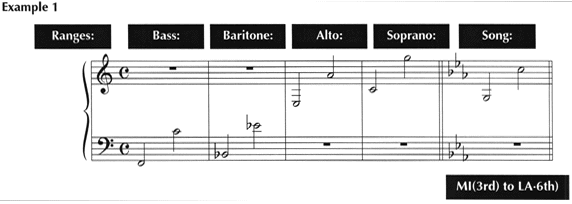
We will now take an example of a song, written in the key of Eb
in which the range is from 'G' to 'C'. Then we will state the vocal
range of a soprano voice, an alto voice, a baritone voice and a bass
voice. Now that we have the information we need (the span of each of
the different voices and of the song), we can determine the best key
in which each of the singers would perform the song.
|
|
Now we can work our process four times, once for each of the
different singing ranges.
1. Bass
range: 'F'to 'C' / Song range: MI(3rd) up to
LA(6th).
| a. |
'C' is the highest comfortable tone for the
singer. The top note of the song is LA or the 6th of
a key. 'C' is LA or the 6th tone of the key of 'Eb',
therefore the bass voice would sing the tune in the key of
'Eb' (which happens to be the standard key the music of the
tune was written in). |
2. Baritone range: 'Bb'to 'Eb' / Song
range: MI(3rd) up to LA(6th).
| a. |
'Eb' is the highest comfortable tone for the
singer. The top note of the song is LA or the 6th of a key.
'Eb' is LA or the 6th tone of the key of 'Gb', therefore the
baritone voice would sing the tune in the key of 'Gb' (this
key has 6 flats, and is often avoided. Often the Imathmatical
key' can be moved up or down one half step and still work
for the singer, and easier to play in for the
instruments). |
3. Alto range: 'E to 'A' / Song range:
MI(3rd) up to LA(6th).
| a. |
'A' is the highest comfortable tone for the
singer. The top note of the song is LA or the 6th of
a key. 'A' is LA or the 6th tone of the key of 'C',
therefore the alto voice would sing the tune in the key
of 'C'. |
4. Soprano range: 'C'to 'G' / Song
range: MI(3rd) up to LA(6th).
| a. |
'G' is the highest comfortable tone for the
singer. The top note of the song is LA or the 6th of a key.
'G' is LA or the 6th tone of the key of 'Bb', therefore the
soprano voice would sing the tune in the key of 'Bb' (this
singers range is greater than the span of the song melody and
the soprano could have a choice of singing the song in
'Bb'or'Ab'or'A. Typically they will sing the first
chorus in the key of 'Ab', then modulate and sing the
second chorus in the key of 'A or
'Bb'). |
Use this process every time the subject comes up of picking an
instrumental or vocal key. It is fast, easy, and gets the job done!
Good luck!
Dick Grove |
|

|
COMPING
& CHORD MELODY
by
Dana Rasch |
|
Every time you play a chord, the
top note is considered a melody note. Jumping all over the neck
because you only know one shape of a chord type can create weak
melodies. Try to find ways of tying your chord progressions together
with melodies that either have common tones, move scale wise (half
or whole steps), or sequentially (repeated motifs).
Here are
some ideas to work with in developing your ability to be spontaneous
using common tones.
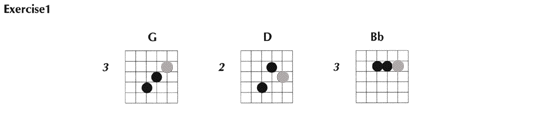
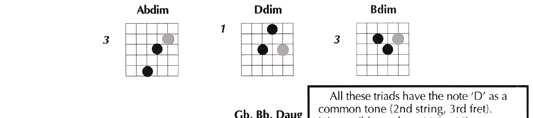
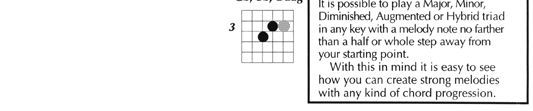
In playing the following triads , the gray
note is the common tone. Try moving them up and down, and by half
and by a whole step. Once you feel comfortable with this idea try it
on different string sets and in different areas of the
neck!
|
|
|
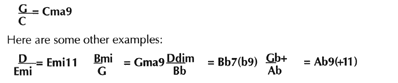
| Don't forget! Triads can be
thought of as upper extensions of larger chord types or, as
explained in Grove harmony, 'Assumed Roots'. |
|
Since triads are so flexible on guitar, it is easy to
understand how important it is to know your triads all over the
neck, in all keys, and to have some ability to voicelead
them.
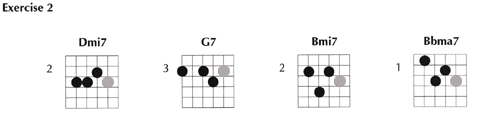
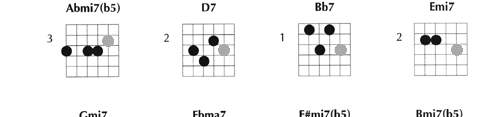
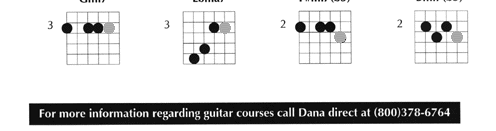
The following example shows the same idea with 4-part
chords. This is certainly not all of them, but you'll get the idea!
If you have all of these shapes under your fingers and develop a
comfort zone with them, your comping and chord melody playing has to
improve substantially!
Try finding as many 4, 5, 6 and 7 part
implied chords as you can, keeping the same 'D' top note. You'll be
surprised at how many there are.
|
|
BLUES
HARMONIZATION
by Dick Grove |
|
It would not be an exaggeration to say the what we call "the
Blues' is the most unique musical form ever invented! It defies all
the European rules of 'what is possible' and yet speaks to every
soul in a personal and undescribable manner. Every contemporary
musician, whether self-trained or schooled could consider the Blues
as his or her 'right of passage' into being a spontaneous musician.
One can play the blues every day of their life and still feel an
energy and 'right now' anticipation that transcends any other form
of our music of today.
Like Louis Armstrong said when someone
asked him 'what is the Blues", his answer was, "if you have to ask,
you'll never know" - or words to that effect! The Blues is a 'state
of mind'that is a reflection of the human condition, stated in a way
that all can understand perfectly and understand without a word
being uttered. When Joe Williams (of the Court Basie Big Band) sings
the Blues it is immediately captivating.
How is it that we
can listen to the 'same thing'over and over and still be totally
caught up in the message? I think the answer is the naturalness of
the music, and the complete avoidance of 'the rules'of music. It
makes its own statement, but in a unique way that transcends any
language. It is its own language of life, and that is why we all
relate to it so completely!
To talk about the Blues is like
talking about religion - there are untold sects or 'styles' of the
Blues. In that sense, the Blues crosses over the evolution of
musical styles. It was around in 1910, and it is alive and growing
in 1998. The point to all of these positive comments about the Blues
as part of our musical heritage, is that no matter the stylistic
shading that is applied to the Blues, there is a basic core existing
that should be understood if we wish to advance our own abilities to
play the Blues and evolve our own ability to have the voice of the
Blues in our music.
|
|
The real basis of the Blues starts with the 12-bar form, although
the Blues style and feeling can be adapted to any form. George
Gershwin's "Porgy and Bess" is a timeless creation that utilizes the
Blues feeling but with a symphonic orchestra and not with the
traditional 12-bar form. The 12-bar form however is catching - you
can never hear enough choruses when a master is playing the
Blues.
The next essential aspect of the blues is the
flexibility and looseness of the way melody and harmony relate to
each other. This is the area in which the so called 'rules' seem to
get broken, but it still sounds great! How can this be possible? How
does the player understand this? The secret is in the fact that the
major scale of the key signature is 'bent' - or what I term
'Modified'. This creates vertical relationships that allow the
melodic tones to chromatically stylize the music, and added to the
rhythmic feel or 'groove'allows the player to freely create Bluesy
sounding melodies, by ear, in a very unique manner.
What we
wish to look at in this discussion of Blues Harmonization, are the
many possibilities we have to vary the chords in a 12-bar Blues. The
principle reason to vary the chords is to accommodate a melody, or
to provide new improvisational changes to play on. Style also is a
factor in the sense that when jazz is applied to the Blues (as
opposed to Rock 'n Roll), the chromatic character of jazz begs for
more interesting and larger chord forms. |
|
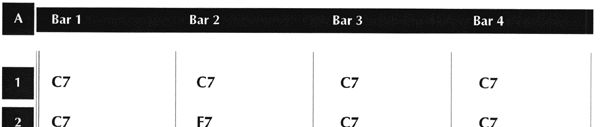
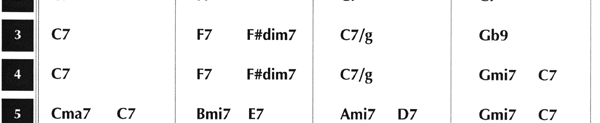
The form of the 12-bar Blues is three 4-bar segments which we
could identify as the A. B & C sections. We are going to look at
possible chord progressions for the 12-bar Blues in that A. B, C
format. You will see a number of different harmonic solutions for
first, bars I through 4 of the Blues, (or the A section), secondly
bars 5 through 8 (or the B section) and lastly bars 9 through 12
(the C section).
We will start with the basic I - IV - V
Blues, and evolve to more jazzy, chromatically intense chord
progressions. What is neat about this presentation is that any
version on a line can be interchanged with any other line, with the
sum result of literally dozens of possible chord progressions that
will play nicely on the 12-bar Blues.
Here are some ways you
can work with the material in this article:
|
| 1. |
Get your Band In The Box out and make tracks
from the possible progressions in the above table. Make Line A
first, play with it till you are comfortable, then change your
chords to Line B Play with those changes till comfortable, now
change to Line C, then D, then E |
| 2. |
Play them in different keys |
| 3. |
Now lay down progressions mixing segments from
the different lines - find out which ones you personally
prefer - do your thing! - |
| 4. |
Now compose a Blues line, and use our table to
harmonize you melody by deciding bar by bar, which chords
you hear fitting you melody best. Try one way then another.
Think of our table above as a palette from which you can
pick and choose the changes that support your melody in the
most pleasing way. |
| 5 |
If you want even more direction in making your
melodies sound like better melodies, think about getting my
ONE SHOT VIDEO lesson on 'The Secrets of Great Improvisation'
package. Check it out on our web site under ONE SHOT VIDEOS.
You can really get a lot from it, and now you have unlimited
resources for chord progressions, tempos, keys and rhythmic
feels you will really be on your way to being a great
Blues player. |
We will be doing more articles on harmonizing melodies in 'MUSIC
NOTES'.
I recommend saving your downloaded copies in a loose leaf
binder, as the articles will connect from one to the next. You will
not only pick up a lot of helpful techniques and tips on improving
yourself, but experience our approach to teaching and getting to
those areas that produce immediate results. Once you get involved
with our regular courses using our videos, cassettes and books you
will make real progress towards your goals.
Have fun with
this one and 'GO FOR IT'!
Dick Grove
|
|
This is only the TIP of the
iceberg!
Find all of the answers by checking
out
The Dick Grove 'School Without Walls'
http://www.dickgrove.com/
DID YOU KNOW?
If you take every possible
chord there is,
from 3-note to 8-note,
that they are all
sourced from only
FOUR BASIC SCALES
There is no need to
try to learn and memorize
a bunch of exotic scale names and
formulas-
that only get in the way of playing
freely
what you hear in your head
The four scales are:
THE MAJOR
SCALE (including the modes)
THE MELODIC MINOR SCALE
THE
8-NOTE SYMMETRIC SCALE
THE WHOLE TONE SCALE
The Dick Grove CHORD FAMILY
CONCEPT
takes you through ALL chord forms and
in an
organized and logical format that shows
you all their scale
sources and HOW TO HEAR THEM!
Check out our web site Course
Descriptions for
'See it- Hear it / Hear it - Play it'
Parts 1 & 2,
Chapters 10 through
19 |
|
|
We would appreciate your comments on
this and all or our MUSIC NOTES Electronic Newsletters!
Drop us an Email to: Editor
MUSIC NOTES
dana@beyondchops.com | |
Enjoy!
Dick Grove and Dana Rasch |