|

|
|
|

|
|
GROVE /
RASCH MUSIC EDUCATION SYSTEMS ELECTRONIC
NEWSLETTER
No. 1 - January 15th
1998 | |
 |
A NOTE
FROM DICK
GROVE |
Welcome to our first Electronic Newsletter. We are
looking forward to being in touch with you each month and providing
you with interesting and informative articles on the many facets of
contemporary music that we hope will make your music more enjoyable
and satisfying to you.
We will also be able to announce many
of the new courses and instructional packages that we have on the
drawing board to you, as well as keep you updated on our clinic
schedules and appearances.
As a registered subscriber to our
‘MUSIC NOTES’ Electronic Newsletter you will also be offered special
discounts on some of our most popular courses as well as
introductory prices for new products.
If you are not already
a student of DGSWW we hope as you enjoy these mini-lessons each
month that you will come to realize our teaching approaches are
unique and get to the point. If you would like to see them
applied to indepth courses that will take you ‘miles’, give us a
call and we will make sure you are in the right course for your
background and goals.
Dick Grove
|
|
HARMONIZING
MELODIES
Part 1
by Dick
Grove
Starting with this issue of Music Notes, I will be
writing a series of articles about harmonizing melodies. This is an
important aspect of the creative process, and applies to not only
writing songs, but to playing introductions, endings, your
understanding of how songs are harmonized, and is also a kind of
applied eartraining, dealing with harmony. |
|
Our contemporary music (from rock to jazz), can be thought of as
being influenced by four basic harmonic styles. They are: modal,
blues, the II- V - I styles (diatonic & chromatic), and
symmetric (found in fusion music and more compositional areas of
music as well as progressive jazz and rock). Each one of the
articles in this series will explore one of these four areas, and
hopefully can give you some practical techniques and approaches to
use in your own creative endeavors. |
|
In styles of music such as all the areas of pop music, pop
ballads, country, etc., a unique approach to harmonizing a melody is
connected to the restriction of the modal scales. If you are not
familiar with modes, the following is a brief overview of what is
meant by this term.Modes stem from the ancient Greek terms for
7-note scales, made up of different combinations of whole and
half-steps. Our major scale is a mode (Ionian), and the
remaining six modal scales can be thought of as the intervals
between tones found when you displace the major scale. In other
words, if you take the intervals found when you move from the 2nd
tone of a major scale to the 2nd tone an octave higher, you have the
Dorian Mode. It works like this:
|
Moving from the: 1st tone of a major scale
up one octave to the 1st is called Ionian: 2nd
tone of a major scale up one octave to the 2nd is called
Dorian: 3rd tone of a major scale up one
octave to the 3rd is called Phyrgian: 4th
tone of a major scale up one octave to the 4th is called
Lydian: 5th tone of a major scale up one
octave to the 5th is called Mixolydian: 6th
tone of a major scale up one octave to the 6th is called
Aeolian: 7th tone of a major scale up one
octave to the 7th is called
Locrian.
All these modes are therefore linked to the major scale as the
source of their intervals. We will call that major scale the
relative major. The strongest harmony that defines these modal
scales will be the IV – V triads of the relative major scale.
|
| How Modal
Triads Can Harmonize
Melodies |
Triads contain no dissonant intervals, therefore, any triad can
move to any other triad without the added problem of the preparation
and resolution of out-of- scale leading tones. We will now discuss
how to find the possible triads that will harmonize the melody you
compose.
There are four types of basic triads: major,
minor, augmented and diminished. We will restrict our triad choices
to only major and minor as they have the strongest shapes,
containing a Per5th of the triad as opposed to a diminished 5th or
augmented 5th. |
|
There are six major or minor triads that can harmonize any melody
note. The working procedure to use is to take the melody note that
falls on a strong beat of a measure (1st and 3rd beats in 4/4, 1st
beat in 3/4), and decide which of the six triads your ear prefers at
that point of the song. Moving to the next strong beat, you go
through the same procedure, picking a triad that not only contains
the melody note, but one that you think sounds good moving from the
previous chord.
This technique is called Melodic Triads. The
melody note is the key to deciding on which triads are
possible. |
|
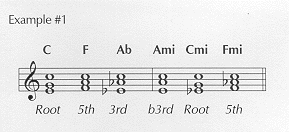
To demonstrate this technique, we will take a random melody note
that you wish to harmonize. As Example #1 shows, the melody note ‘C’
can be harmonized by three major triads or by three minor
triads.

We can see that the melody note functions differently with each
triad. Below the notes you will find the function of each melody
note to the given triad.
|
| How To
Decide Which
Triad |
The choice of which of the six triads to use is an ‘ear’
decision. The ‘context’ of the music will influence your ear to a
great extent, meaning that the previous chord is noticed as well as
the key signature itself, from which the melody is inspired. The
connotation here is that we will tend to use Melodic Triads that
contain notes diatonic to the key signature more than using triads
that contain chromatic tones to the key signature. In this sense, of
our six triads shown in Ex.#1, the ‘Ab’ triad would be most
chromatic and less used, while the ‘C’, ‘F’, and ‘Ami’ triads would
be the most used. |
a. compose a 4 to 8 measure
melody b. decide where your ‘ear’ hears the
chords changing c. based on the
melody note at the point of each chord change, determine the
six
possible Melodic Triads, (3 major and 3
minor) d. from these six, pick one
possibility you like, always going back to the beginning
to
hear the entire chord progression.
Each triad you pick
is functioning as either a IV or V triad (if major), or a II or
III triad (if minor) of the relative major scale. This is why,
in the study of modal harmony, the triads are the preferred shape,
and the change of triad possibility simply means that you are
changing the momentary scale at that
point
Next time - Blues
Harmonization!
Enjoy -
Dick
Grove
P.S. - Call me if you have any questions!

|
MELODIC
CONTOUR
by Dana Rasch |

|
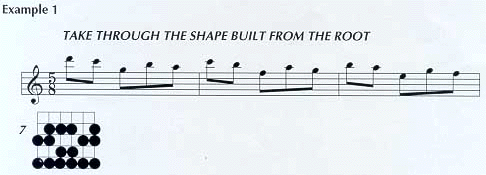
In “Beyond Chops, Part 1" we talk
about a concept called Melodic Contour. Melodic Contour is a
relatively easy idea to understand, but the practical application of
the concept is considerably more difficult.
Basically, the
idea is to create a motif consisting of three or more notes, and
play that motif (or idea) starting on every note of any one of the
five conventional positions of the major scale. Obviously, this
could be applied to any scale, but if you start with the major scale
it is quite a bit easier to deal with!
Working with a motif
or sequence of 3 or 4 notes is relatively simple, but when even one
more note is added to the sequence of tones, things change
dramatically as there is more difficuly with each added
tone.
When working with this idea, there is a natural
tendency to try and memorize the sequences throughout the whole
position. Approaching this concept in this way is fine if you wish
to primarily develop your technique, but the real idea of Melodic
Contour is to help you develop your improv ear. By approaching the
concept in a systematic way, melodic contour starts forcing you to
hear an idea and get it out of your instrument (instead of the
habitual lick playing that we all get caught up
in).
The primary thing I stress to students when working with
this concept is to ‘hear it first’, if you are even half way
comfortable with the shape or position of the major scale you are
working with, you should be able to take the motif through every
starting note, no matter how difficult the sequence is, if you hear
the idea first!
|
|

|
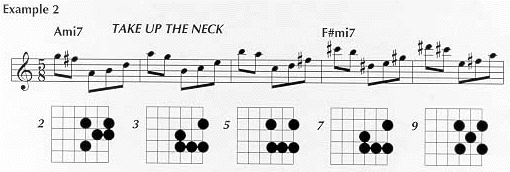
| For those of you already familiar
with Melodic Contour, here is another approach that is more linear
and forces you to use the visual guide tones as well. |
|


|
|
THE ARGUMENT FOR
SOLFEG OVER THE NUMBER
SYSTEM
by Dick Grove |
|
Every musician deals with their level of musicanship in one way
or the other. The primary obstacle most encounter is to get their
ability to hear and relate to music to a level where they can be
instinctive musicians. Some do it by plugging along year after year
until it evolves to the point where they can ‘get to their music’ in
a natural, spontaneous manner. Most never make it and end up
compromising their potential by settling for a less productive
solution.
Those who try to study music and improve in these
areas have the options of private teachers, colleges, universities,
method books, CD’s, summer camps, etc. One way or the other they are
working with teachers and authors who determine how to develop a
person’s musicianship.
Musicianship itself is comprised
of two main categories; theory and eartraining. In the
discipline of eartraining, private teaches, authors and college
curricula chose various tools and approaches to help the student
attain their goals. Most use the method they themselves studied, or
in the case of schools, they use what has always been used.
Professors with tenure balk at any changes!
When one looks at
the possible methods that can be used, they find an endless
controversy in music education that has to do with how we relate to,
and work with, musical tones. Obviously, as a student of music tries
to improve their musicianship and experience the higher levels
of musical awareness and potential, there is a need for tools and a
terminology that will expedite that process and create more quality
productive results. |
|
There are apparently two ‘roads’ that are generally employed to
reach these goals. If a poll was taken of music departments in
universities and colleges you would probably find that the majority
of approaches prefer the number system. This simply means that you
relate to each degree of a scale within a tonality as 1 to 7.
Using numbers is an accepted device in the area of chord
progressions as they are labeled using Roman numerals to represent
the roots of chords, thus the standard IImi7 - V7 - Ima7 terminology
for our most prevalent progression of chords. Whereas more
traditional harmony will also take that approach and use lower case
lettering for minor chord and upper case for major (iimi, vimi,
IVma7), most contemporary theoriests will use upper case for all
degrees of a scale from which chords are built.
Scale degree
tones are different than roots of chords! Any discussion of methods
to represent scale degrees should be based on why we need an
approach to specify each tone of the scale. The point of
having a practical and helpful approach is to efficiently train our
ear to identify the impression made of each diatonic and chromatic
tone of a key center.
The term Diatonic means those tones
contained within the restriction of a scale while Chromatic relates
to the remaining tones not contained in a scale. Our contemporary
musical styles are based on melody and harmony that in this sense is
either diatonic in character or chromatic (i.e. melody and harmony
that stay within the confines of major scales (or modes) or are
based on altered major scales, (the most important of which is the
Melodic Minor scale). Any melodic tone or chord that contains a
tone chromatic to a major scale creates a minor key
center.
We can alter each tone of a major scale up or down a
half-step. When a scale tone is sharped or flatted, that tone then
replaces the diatonic tone and a chromatic half-step has been
created. We therefore end up with a possible 35 different names of
notes.
To deal with our contemporary music styles, we
obviously need a reference terminology that will allow us to
accommodate all of these 35 names and even more importantly, in a
way that relates to the sharping or flatting of a diatonic tone
of a major scale. Anything lacking in this versatility would
limit our learning capacity and at worse, neglect some important
styles of music that we should be able to deal with.
I have
found that the number system is used for one of two reasons: (1) it
is easier to get started as the student already knows the numbers
(2) the teacher or music department does not understand the
limitations of using numbers as opposed to the solfeg
system.
The number system will work fine if the music is
diatonic and there are few alterations. This is why eartraining in
the more traditional context you will find that the number
system is maintained. Realistically however, contemporary music,
including more and more pop styles, are beginning to use more
altered harmony. When you realize that the purpose of eartraining is
to prepare the musician’s ear to hear the music they create, then
there can be no other conclusion but to use an approach that will
condition the ear to hear both diatonic and chromatic
harmony.
Anyone deciding to stay with the number system is
not really aware of chromatic harmony and how it should be used in
from an eartraining standpoint. The conclusion from all of this is
that when you study using the number system, as opposed to solfeg,
you are not getting a complete education and your evolving level of
musicianship will get ‘stuck’ in the early stages of
development! |
|
Solfeg is a European concept. Most universities in Europe use
this approach, however there are two versions of solfeggio
(shortened to ‘solfeg’). The more traditional is called a ‘fixed
DO’. This means that the tone ‘C’ is always called ‘DO’ no matter
what scale you happen to be using. It is an extremely difficult
approach. It is based on the idea that all scales can be thought of
as an altered ‘C’ major scale. This is true and works up to a
certain point but as music has evolved in the past two hundred years
it has become much more sophisticated and complex. So much so that
to deal with music that changes key centers as rapidly as with every
beat of a measure, the fixed DO concept creates an impossible
gauntlet of obstacles that results in a meaningless victory. What I
mean is that even if you could handle a composition in fixed DO you
have not accomplished the goal you are after to begin with. The
eartraining technique becomes falsely more important than why you
are doing the eartraining to begin with!
We do eartraining to
‘hear’ music in a new and clearer fashion, and not to be caught up
in what to call a tone (as opposed to hearing the tone). The best
and most productive version of solfeg is called ‘moveable DO’. This
means that the first note of the major scale of a key center
is considered DO. If you are in ‘F’, then ‘F’ is DO. If you are in
‘Ab’ then ‘Ab’ is DO.
The ability to hear diatonic and
chromatic tones of a key is complicated enough (35 letternames!)
although when approached in a comprehensive manner the problems can
be simplified a great deal. However once the ear knows and can
identify the possibilities within a key center, we find that all key
centers have the same relationship and sound. The result is that no
matter what key you are in, the relationship of tones to each other
is exactly the same, the patterns are the same, and the process of
absorbing the technique is much easier. |
|
Solfeg has its roots in the 11th century. The syllables used
today come from Guido d’Arezzo’s hexachord system of solfeg. They
correspond to the first syllable of each verse of the hymn to Saint
John. ‘UT queant laxis REsonare fibris MIra gestorum FAmuli tuorum
SOLve, polluti LAbii reatum, Sancte Iohannes. The label for the
seventh degree came a bit later and was constructed as the ‘S’ of
Sancte plus the ‘I’ from Iohannas = SI. In American teaching, the
seventh degree is called ‘TI’ instead of ‘SI’, however in all
Spanish speaking countries ‘SI’ is preferred. It is clear then that
this more southern European nomenclature is deeply rooted in a
tradition of centuries.
The process of identifying all the
letternames with the appropriate syllables can be accomplished over
a period of time, starting with the diatonic names, and then
to the chromatic. The chromatic names start with the same letter as
the diatonic and therefore are all logical and easy to remember.
The most practical reason for using the moveable DO solfeg
system concerns the chromatic tones of a key center. Comparing this
system to the numbered system makes its case immediately. As
eartraining involves singing the correct name for a specific
tone, the literal act of singing makes you sing these special
‘lyrics’. It makes more sense to sing a one-syllable name for a tone
as opposed to a 2 or 3-syllable name. For example, the flatted
3rd in the key of ‘C’ would require two syllables to sing as
numbers. You would sing ‘flat 3'. In solfeg, you would simply sing
ME. Singing the augmented 4th in the key of ‘C’ would compare +
(plus) 4 to FI. To sing the lowered 7th would be ‘flat seventh’ or
TE.
So in tempo or rapid moving rhythms you actually cannot
sing multi-syllables using the number system! Try it! I rest
my case!
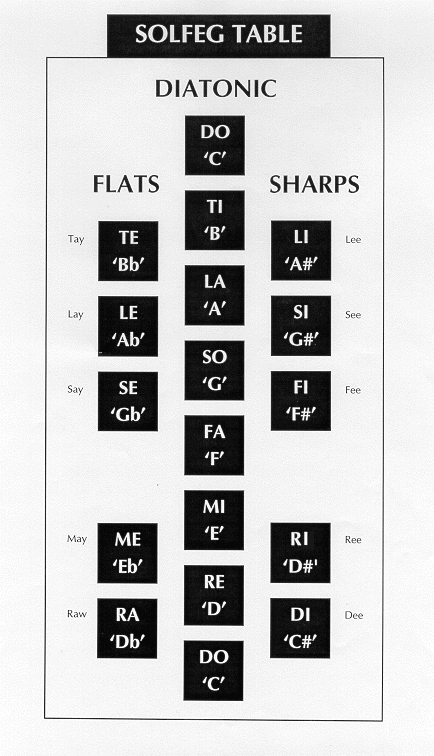
Below you will find a table of all of the diatonic
and chromatic solfeg names, and their equivalents relative to the
key of ‘C’.
|
|

By substituting any other scale, you of course could
arrive at all the syllables in all keys. To aid you in this here is a
link to take you to a page for you to print out. This page is a
form that allows you to write out the names of all the solfeg names
in any key you wish. Just keep printing copies of the form to get as
many as you would like to do. |
The above table, containing all
the diatonic and chromatic solfeg syllables, will give you a
solid reference source to understand this
approach.
We use this approach in all the School Without
Walls musicianship and applied courses, with the result that the ear
is trained in an efficient and practical fashion to be able to
recognize melodies and harmonies.
Our course methods take
the identification of scale tones a step farther and using
this terminology, show you how to hear harmony and modulation. |
|
ASSIGNMENT
If you are interested in working with solfeg, there are two
things you can do. The first is to learn the above table by writing
it out in different keys. If you enroll in the ‘See It - Hear It /
Hear It - Play It’ Part 1 Musicianship course you will then learn to
apply solfeg to real music, from a melodic and harmonic
standpoint.
To aid you in this first step, just
use this link: to download a Solfeg Form that you can then fill out
to have the relationship of the solfeg syllables in any key
you wish. The form is based on the above table but it designed so
that, starting with the major scale of each key, you can write
in the lettername of each of the solfeg syllables.
Special thanks to George Abufhele of ProJazz, Chile
for the history of solfeg info!
|
|
We would appreciate your comments on
our first MUSIC NOTES Electronic Newsletter! Drop us an Email
to: Editor
MUSIC NOTES
dana@beyondchops.com | |
Enjoy!
Dick Grove and Dana Rasch |