Site Menu


MASTH.gif (2119 bytes)

GROVE / RASCH MUSIC EDUCATION SYSTEMS ELECTRONIC NEWSLETTER

No. 7 - July 15th 1998

 
Dick_Grove.gif (25081 bytes)

A NOTE FROM DICK GROVE

Welcome to our July issue of MUSIC NOTES! We hope that by now we have become a habit with you and that you are looking forward to each new set of articles.

In this edition we are talking about two areas that many of you ask about and seem to be interested in getting more information. The first concerns improvisation and playing outside, so it discusses what that really means. The second article explains the common term, turnarounds.

We again remind you to check out our Talk Forum at http://www.dickgrove.com/musictalk

It provides a good opportunity to network with other students and musicians in your area of the world and with similar interests in contemporary music.

I always appreciate some feedback on how you like the articles - you can reach me at
dana@beyondchops.com

Musically -

Dick Grove

hairline.gif (187 bytes)


PLAYING 'OUTSIDE'

by Dick Grove

There are terms that are commonly used to represent different approaches to improvisation. These terms relate to styles in the sense that the more sophisticated styles of improv offer the most possibilities, and therefore it is in these areas that the different concepts of improvising arise.

PLAYING 'OVER CHANGES'


To review some of these terms, we have the first which we call playing 'over changes'. This means to improvise a melody that sounds good, everything fits the harmony in one way or another, but the notes of the improvised solo do not define the chords in the progression. Another way of saying this is that if a solo improvised melody was heard without hearing the chord changes at the same time, you would not be able to determine what the chords were from the improvised melody. This style of playing is common for rock, funk, and other popular contemporary styles. It is the 'sound' of the Blues; funky, bluesy and fairly repetitive.


PLAYING 'THROUGH CHANGES'


Playing through the changes is the other side of playing over changes. The improvised solo now is based on hearing melodies that are built around the definitive scale tones of each momentary key center of the chord progression. Particularly in jazz, improvising on standards and on show tunes, the character of the harmony is such that keys change constantly. By this we do not imply that the key signature changes, but that the momentary key does. Another way of relating to this is that when there are accidentals in music, that is usually the indication that the momentary key has changed.

It is possible to be in any of 12 major or 12 minor key centers (when you include the enharmonics of Cb/B, Gb/F# and Db/C# there are then actually 15 major and minor key centers.  Some compositions on which we would improve a melody will have progressions that change the momentary key every beat, and although rare, changing key centers every measure is commonly found.

This style of improvisation obviously takes a more developed ear, more experience, more musicianship to understand and hear altered chords and chromatic harmony.

Both of these approaches are the subject of my ONE SHOT VIDEO package called The Secrets of Great Improvisation. In the Video/Book/Cassette package you learn these distinctions, and how to apply them right away to your improv. The cassettes gives you practice play-along tracks designed for C concert treble and bass clef instruments, Bb and Eb instruments. You can check this out by clicking [Here]


PLAYING 'OUTSIDE'


When we improvise, several aspects of music are occurring at the same time:

a. the rhythmic phrasing
b the melodic shape/contour of the solo
c. the relationship of the improvised melody to the harmony

Playing outside affects the harmonic relationship of your improvised solo so that even though it sounds 'out' and different, the rhythmic phrasing and melodic shape remain conventional, grounding the solo in a conventional and natural foundation. It is only the relationship of the melody notes to the harmony of the song that will be changed.

HARMONIC CONSIDERATIONS


More sophisticated styles of jazz, jazz/fusion and progressive jazz are based on using the full potential of altered chords. In chromatic harmony there can be three types of 5ths, three types of 9ths, two types of 11ths and two types of 13ths. This is an imposing selection of possibilities from which chords are constructed.

The deciding factor that organizes all of these possible combinations of 5ths, 9ths, 11ths & 13ths is that each combination will form a conventional 7 or 8 note scale. The primary scale that will account for half of the possible combinations is the Melodic Minor scale. The other half of the possible combinations come from the 8-note symmetric scales. This means that all of the possible combinations of altered tones can be compressed down to only two scales that an improviser must know intuitively in any key. This simplification makes a giant stride in tackling an imposing challenge like this.

Our contemporary music1s based on polytonal harmony. This means keys superimposed on top of keys. To better understand this concept, Example 1 illustrates triads built from the root, 5th and 9th of a 'C' Lydian Mode, which is the scale source of major chords from the triad form on up to the 13th(+11).

ex1.gif (19110 bytes)


In this example you will see that the three triads, when stacked on top of each other form the complete stack of tones. We can also see that the implication here is that we are combining the keys of C, G and D.Thus the polyharmonic relationship is shown in an obvious and dramatic way.

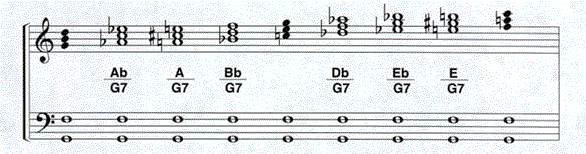
Harmony and the chords that represent the harmony of a composition have two characteristics, namely functioning as either resting chords or active chords. I chords in a key are resting, while the IImi7 and dominant chord forms are active. As we have seen the polyharmonic relationships inherent in the I major, resting chord, the majority of chords are active. The primary active chord in each key center is the V7 dominant chord. On every dominant chord there are 11 possible tones (all tones except the maj7 of the chord). From this basis, it is possible to have six polyharmonic relationships that all conform to some legitimate form of dominant chord. Example 2 shows you these forms relative to a G7 in the key of Cmi.

ex2.gif (24665 bytes)

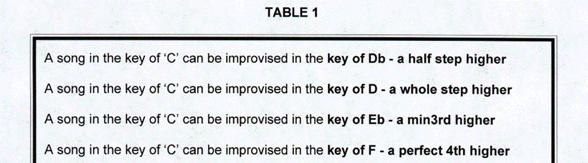
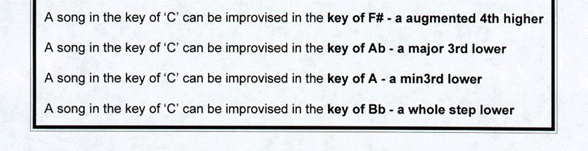
Once you can see that there is a natural relationship of the major triads to the G7, we can now think of these major triads as keys that our improv can be based upon. This all translates to the following:

ex3a.gif (51303 bytes)
ex3b.gif (49566 bytes)

This approach should be qualified in the following sense: we do not mean that you literally play a song in a different key than the concert key. What we are getting at is that portions of an improvised solo will go outside, then return to normal playing over or through changes.

There are preferred harmonic settings that are more effective for playing outside - such as the Blues (in which case an entire 12-bar chorus could be played in a superimposed key), two or four bars within a song, situations where there are two bars with one chord, and the new sound adds interest and dramatic color to the solo.

The playing outside creates a kind of melodic tension and then when you return to normal improv, that tension is resolved.

The reason why the outside melody is acceptable to our ear is the fact that harmonically the notes have a natural relationship with some normal form of dominant chord, and the plurality (or multiple relationships of notes to chords) of the majority of tones will fall into place as some extension to the given chord.

PRACTICE SUGGESTIONS


A simple suggestion on how to get started with this concept is to do the following:

a. Pick a tune, and a portion of the tune where you wish to play outside
b. If you have a play-along track, or can make one with your 'Band in a box' program, it is best.
c. Now create a lick or idea like you would normally improvise on the given chords at the portion of the tune you have picked.
d. Now play the track and play your melodic idea on each of the superimposed key relationships shown in Table 1.
e. Work to be able to accomplish this spontaneously. Try to use the same relationship each time on a tune until the chord/key relationship is understood by your ear.

Normally, playing outside is considered an advanced improv level. If your own development is still pretty basic, you can at least understand what is going on when you listen to your favorite players, and consequently get more out of your listening and conceptual growth.

Have fun -

Dick Grove

hairline.gif (187 bytes)


CHORD PROGRESSION 'TURNAROUNDS'


by Dick Grove


dgswwicon.gif (5330 bytes)


CONTEMPORARY SONG FORM

There are countless different chord progressions! A chord progression is the result of the harmonization of a melody as the movement and placement of a melody in a tonality suggests the proper chords to support it. We have already discussed some aspects of harmonization of melody in our January, 1998 and July 1998 newsletters.

The key to the uniqueness of a song is the melody and lyric (unless instrumental without lyric).
The structure of a melody creates the form of the song. Most of our contemporary music uses common song forms that you hear on 99% of our music. The way we relate to song form in contemporary music is by the thematic construction of the melody.

We use an alphabet letter to represent each portion of the melody, in this fashion. The basic building block of form is the two-bar unit. Each two-bar unit is comprised of a strong measure and a weak measure. Strong measure means there is a greater natural emphasis on that measure as compared to the weak measure. The chord placed at the beginning of the strong measure is therefore the most important harmony for the two-bar unit.

Most natural song forms create 8-bar sections (comprised of four, 2-bar units). The first 8-bar section is labeled the ‘A’ section. The following  8-bar section is now compared to the first, and if it is a repeat of that melody, is called ‘A’ again. If different, it is now labeled the ‘B’ section.This process is then repeated until the complete song is covered. The common forms end up being:

A* A*
A B*
A B C*
A* A B A*
A* A B C*
A B A C*
A B C A*
A B C D*


The melody at the ending portion of each thematic segment of a song will typically become static or resting. This allows the flow of the melody to ‘breath’, and helps to define one portion of the song from the next. The 2-bar units which group together to form the thematic sections of the song can be the way we can relate to the harmonic turnarounds in the structure of the music.

Each two-bar unit consists of a strong measure and a weak measure (strong denoting that that bar, and the first beat of that bar) receive a stronger, natural emphasis than the other beats in the two-bar unit. In sheet music or on a leadsheet, the harmony in this two-bars is usually very simple, staying in the same tonal center, and leading back to the first chord of the next thematic section (which could be a repeat using an A A form, or an A B, moving to a new thematic section).

As the melody does not move and thereby dictate the harmony, this specific area allows us great latitude in changing the harmony to affect a more sophisticated and interesting harmonic impression. This then, is the one or two-bar area called the Turnaround’. The term refers to the leading tones of the harmony ‘turning around’ or leading back to the following chord.


TURN AROUNDS


Within the various song forms listed above, there are combinations of harmonies (represented by the asterisks shown above) in which the following characteristics are present:

a. the melody is not changing - it is a sustained, static tone in the 7th and 8th bars of the
8-bar thematic section, or in the 8th bar only of the 8-bar thematic section
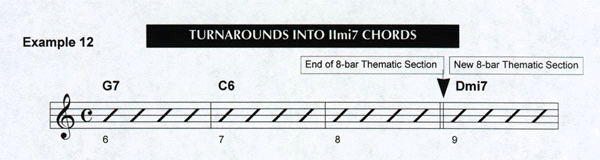
b. the harmony is designed to lead into the first chord of the following thematic section. The majority of songs start on a I major chord or IImi7 chord. So the harmony will lead into this chord. The most typical situation is when the song form A A B A is being used and the harmony in the 7th and 8th bars leads to the first chord in bar 9 at the beginning of the second A section.
c. in every instance of finishing the first chorus of a song and continuing to the second
chorus, the  Turnaround will be found in the last one or two bars of a song.
d. if the melody is sustained, the new harmony would be required to harmonize that held
note, however in a ‘free area’ such as a turnaround, the melody also can be changed
to fit a new harmonization.


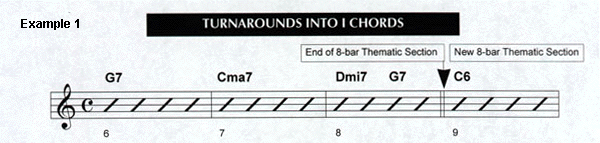
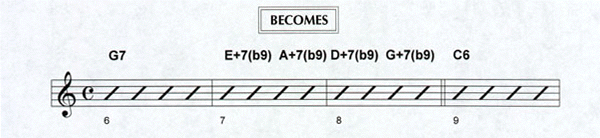
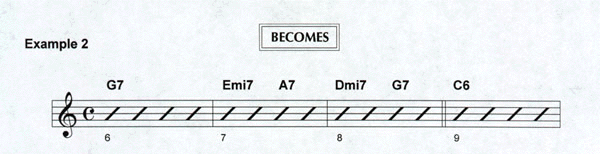
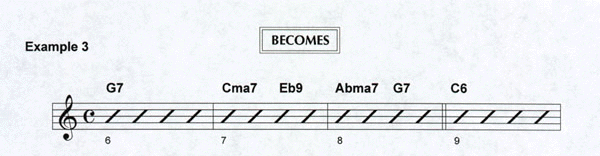
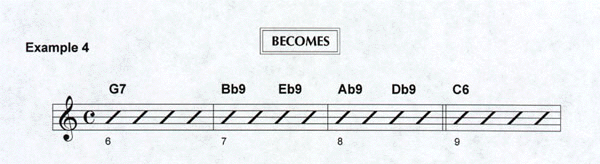
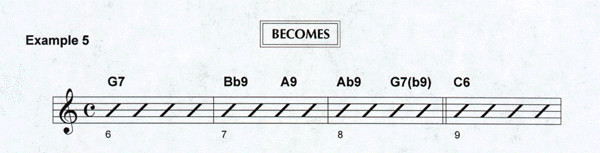
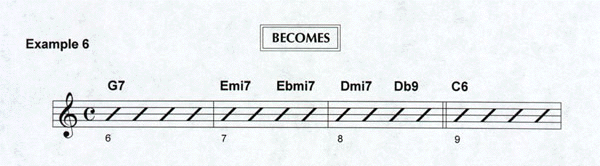
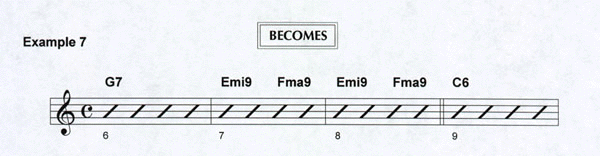
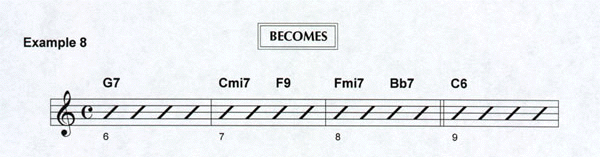
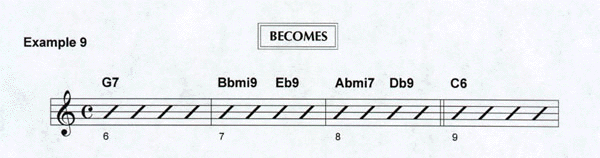
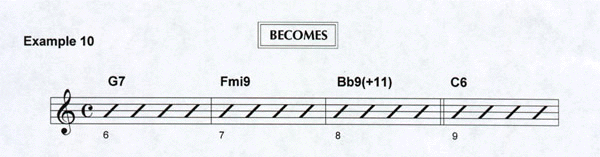
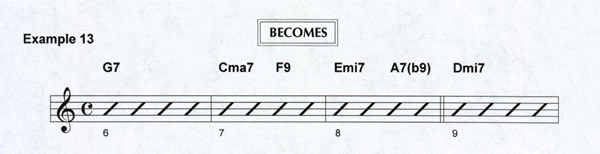
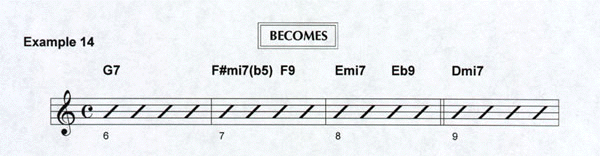
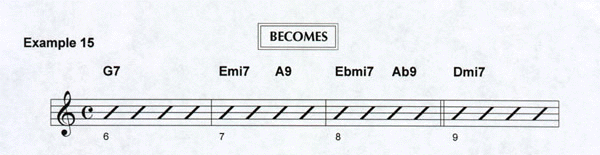
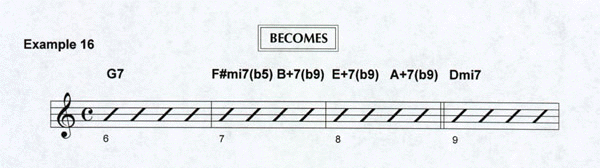
Here are some good examples of new progressions that can be applied to a two-bar turnaround as described above. You can transpose all of these examples into other keys and use some of  these ideas to enhance the way you might play your favorite standards and songs.

ex4a.gif (45201 bytes)
danaex23b.gif (62161 bytes)
ex5a.gif (42845 bytes)
ex5b.gif (41437 bytes)
ex5c.gif (47653 bytes)
ex5d.gif (40428 bytes)
ex5e.gif (44630 bytes)
ex6a.gif (40941 bytes)
ex6b.gif (45582 bytes)
ex6c.gif (40682 bytes)
ex6d.gif (42404 bytes)
ex6e.gif (49141 bytes)
ex6a.gif (40941 bytes)
ex7b.gif (42661 bytes)
ex7c.gif (47538 bytes)
ex7d.gif (43256 bytes)
ex7e.gif (47138 bytes)

hairline.gif (187 bytes)


READERS!
WANT TO NETWORK?

INTRODUCING

THE DICK GROVE
'SCHOOL WITHOUT WALLS'
MUSIC FORUM

HERE IS A PLACE YOU CAN GO TO ...

bull0009.gif (989 bytes)  Leave messages for others studying the same course/lesson that you are
bull0009.gif (989 bytes)  Exchange ideas with others living in the same geographical location as you
bull0009.gif (989 bytes)  Share some of the same interests (musical or otherwise) as you
bull0009.gif (989 bytes)  Get answers to that question about your computer or MIDI setup or.....
bull0009.gif (989 bytes)  Talk to someone already taking a course you might be considering - get their take,  first hand

check it out!
post a message and see what happens

bookmark the url and check in each day to see if you have messages!

go to http://www.dickgrove.com/musictalk

CALL (800)994-7683 or Email dana@beyondchops.com NOW TO GET INVOLVED WITH MUSIC NOTES OR JUST DROP US A LINE TO FIND OUT ABOUT ANY OR OUR COURSES

 hairline.gif (187 bytes)

We would appreciate your comments on this and all or our  MUSIC NOTES Electronic Newsletters! Drop us an Email to: Editor MUSIC NOTES

Enjoy!

Dick Grove and Dana Rasch