
| |||||||||||||||||||||||||||
Our latest edition of MUSIC NOTES has three articles.
Dana Rasch is back with a great one for guitarists, talking about
his ‘Dominant Pentatonic’ scale and its application on guitar. | |||||||||||||||||||||||||||
|
| |||||||||||||||||||||||||||
|
CHANGING TEMPOS & by Dick Grove One aspect of performance that is not safe to ‘take
for granted’ is understanding how tempos can change in relation to
each other and how different ‘feels’ in music are communicated.
Although most versions of a song are done in one tempo and one feel,
you will find yourself listening to many interesting arrangements
containing changes of tempo and feel, and even
To understand and hear tempo changes we must start with the underlying basis of tempo. Tempo means the even rhythmic pulse that music is played in relation to. In a previous MUSIC NOTES article on Counting Off a Band, I explained the relationship of Strong/Weak measures in the meter of our contemporary music, and how within each Strong / Weak measure unit, there are primary beats on the 1st and 3rd beats of a measure of 4/4 time. We related to these point of time as: 1X, 3X, 5X and 7X. The meaning of doing it this way instead of 1-2-3-4 and 1-2-3-4 is that saying 5X tells us automatically that we are on the 1st beat of the weak measure in this two measure relationship. These primary beats are the ‘points of change’ of tempo, in particular, 1X. Occasionally 5X will be used, but not as much. Rarely we will find a tempo change occurring on 3X or 7X. Therefore in our discussion in this lesson, we will refer to 1X as the point of change.
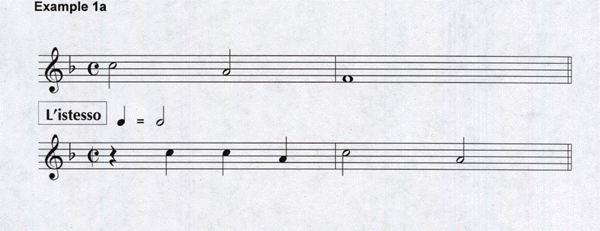
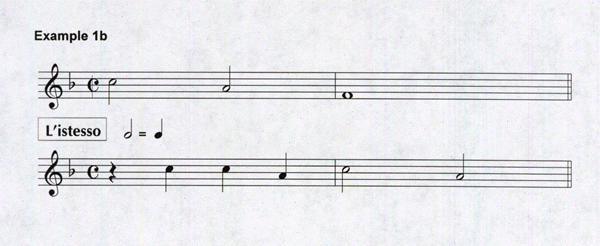
If a tempo changes, it will be a tempo that is:
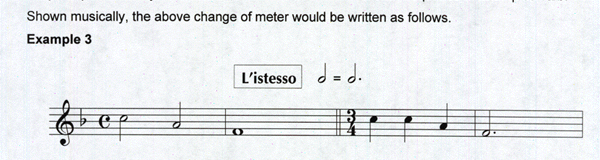
The term L’istesso means ‘the same’. That translates tempo-wise
that the pulse remains the same from one tempo to the other. The
important point here is that if you realize the pulse is the same,
the you know the pulse of the new tempo before it occurs.This
enables you to feel the new tempo ahead of time and makes the
transition from one tempo to the other smooth and even. The music in these situations would be presented as
follows:
In each version of change of tempo, the player has to ‘feel’ the
change of tempo at the ‘point of change’ indicated on the music, or
decided upon verbally. It is not uncommon for the rhythm section
(particularly drums and/or bass) to foreshadow the upcoming change
by implying the new feel in the measure preceding the point of
change. This ‘sets up’ the feel for the players and insures a smooth
transition.
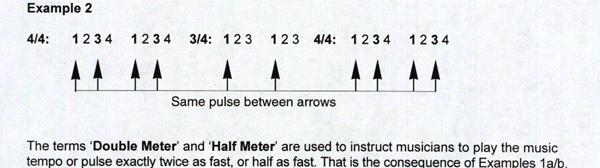
Another very common L’istesso relationship is changing
meters based on the pulse of each quarter note staying the same. For
instance, you can move from a tempo in 4/4 to 3/4, and each beat is
uniform, it is only containing 4 beats per bar in the 4/4 meter and
only 3 beats per bar in the 3/4. So you could also move from 4/4 to
5/4 of 7/4 / 7/4 to 5/4 etc. You could move from 12/8 to 9/8 to 6/8
etc. This is simply changing the number of beats contained in one
bar, whereas the the pulse distance between all of the beats will
remain the same. These are still L’istesso markings. When
these type of L’istesso markings are found, it is generally referred
to as using Mixed Meters. The meters are mixed instead of always
staying in one meter, but the changing of meters are all built
around having the same pulse or distance from beat to
beat.
There is also a situation where there is no set tempo
or pulse. This is playing the music in a free, changing manner.
Singers will often use a rubato tempo for the first portion of a
song, and then start the tempo at some thematic point in the chorus.
Solo pianists will also use rubato tempo for the first statement of
a song, then lock into a tempo for the balance of the
arrangement.
| |||||||||||||||||||||||||||
|
| |||||||||||||||||||||||||||
|
|
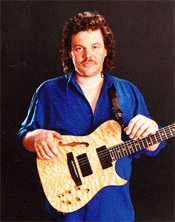 | ||||||||||||||||||||||||||
| Most of you are probably familiar
with the Pentatonic scale. Many students of guitar learn at least a
couple of shapes of this five note scale, sometimes even before they
know the names of the open strings on the instrument. The obvious
reason for this is that 99.99999999999% of all Rock tunes as well as
many other styles use this scale in one form or another. In Beyond
Chops we think of Pentatonic as Major and then do transpositions for
the relative minor when necessary. Thinking in this way (as opposed
to minor pentatonic) allows us to visualize all over the neck very
quickly, in all 15 keys, once you understand the approach. In Beyond
Chops 2 we start to discuss another pentatonic shape called Dominant
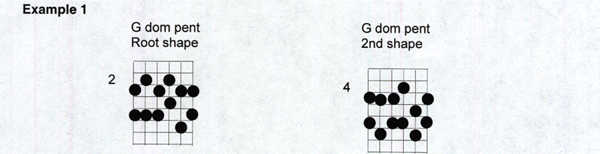
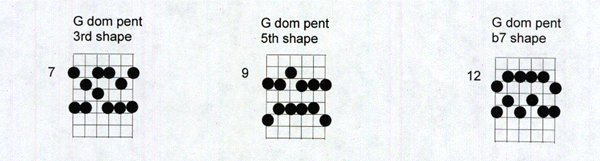
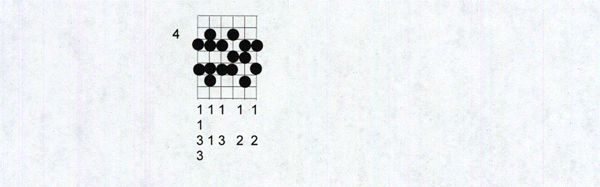
Pentatonic. “Dominant” Pentatonic is the name I bestowed on the following scale degrees 1 , 2 , 3 , 5 , b7..... The reason for the name should be obvious ,these five scale degrees spell out a dominant 9th chord. I personally think all guitarists should have this scale as wired as they do with Maj/Min Pentatonic. This scale works over every chord type except 1, it has 5 shapes that all distribute 2-note-per-string like Major Pentatonic, and the greatest aspect is that it is a perfect tool to visualize the Melodic minor (or as we think of it in Beyond Chops 2 as “Lydian Dominant”) scale all over the neck in all keys. As we work through this series I will show little tidbits of some of the phenomenal ways this hybrid pentatonic scale can be used If you want the complete picture you’ll have to get Beyond Chops. We are a business after all! Here are the 5 shapes of Dominant Pentatonic
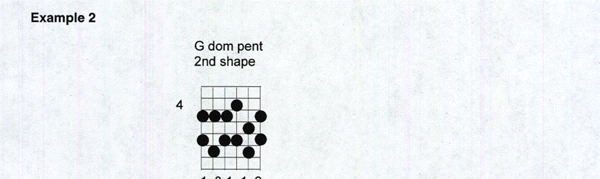
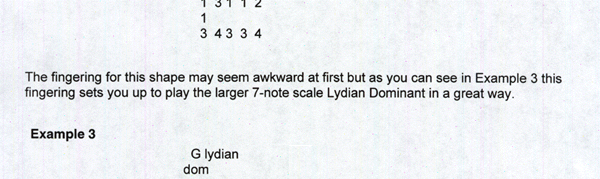
Try memorizing each shape from it’s scale degree as shown on the previous page. Developing a comfort zone with all 5 shapes is extremely important ,as you will find when trying to apply this scale to different situations that will be suggested in future articles. Take care to use the correct fingering for each shape, taking special notice of the shape built from the 2nd. You will find what I believe to be the best fingering for 2nd shape below in Example 2 The fingering for this shape may seem awkward at first but as you
can see in Example 3 this fingering sets you up to play the larger
7-note scale Lydian Dominant in a great way.
After becoming aquainted with the 5 shapes of Dominant Pentatonic
try improvising using the scale over a simple minor 7th chord or a
pedal bass in the following way Use any kind of rock , funk , or
blues groove. Comp over the groove using Dmin7 or a D pedal
bass. | |||||||||||||||||||||||||||
|
| |||||||||||||||||||||||||||
|
HARMONIZING MELODIES Part 2 by Dick Grove Part 2 of this series of articles on the harmonization of melody will present a broad, comprehensive explanation of the precise method of determining the harmony of a melody. The ability to do so demands several attributes, including experience, a good ear, solid knowledge of chords / harmony and an understanding of contemporary musical styles.
In our contemporary music of today we have many unique and distinct styles of music. In pop or funk styles alone, there are many subdivisions of style. Many of the characteristics that label a style however, have to do with the rhythmic traits inherent in the style more than the harmonic. Although the rhythmic character of a melody is critical to the stylistic impression, the variations in rhythms do not impact on the choice of harmonization of the melody. We can say, in a general, across-the-board look, that melodies have as their basic sources, (1) major scales and their displacements the Modes, and Pentatonic scales or (2) altered major scales like the Minor scales and 8-note symmetric scales. This basic restriction of the melodic choices of a tune have an important impact on the harmonization of that melody as the chords are vertical structures taken from the scale of the melodic source. Harmonically, our contemporary music uses four basic harmonic styles (II - V - I divided into diatonic and chromatic). They are:
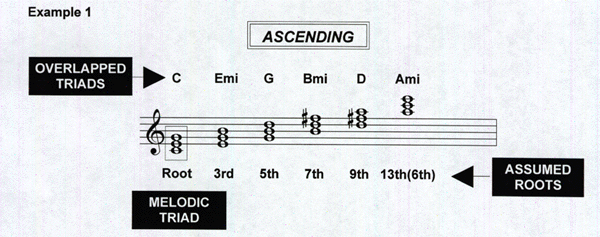
When all of the above are looked at from the standpoint of determining the harmony for a melody, we find that there is one common denominator to selecting every possible chord. The approach I talked about in Part 1 of Harmonizing Melodies (January 1998 Music Notes)can be extended from pop styles to all of the above areas of contemporary music. To review the premise, we are saying that melody notes placed on points of chord change will function as the root, 3rd or 5th of a major on minor triad. We call these the Melodic Triad because the triad includes the melody note. Major and minor triads are suggested as opposed to diminished and augmented triads. Both of these altered major and minor triads do not have a perfect 5th in their construction, and therefore are weaker shapes that are not preferred. There are important advantages to this approach, one of which is the fact that we all know our major and minor triads better than the more complicated chord forms. This makes our accessibility to the triads that harmonize melodies relatively fast and accurate. The second consideration is that when you realize that one premise does the job in any context, you have more directness to developing your technique and speed in the harmonization of a melody. Diatonic harmonic styles are the contemporary sound of today, and the majority of songs are written in these styles. Any style using diatonic harmony makes this restriction of possibilities the easiest of solutions. That is not to say that there is one answer for each situation - there will be at least six possible as there are three major triads and three minor triads. When we say ‘triads’ we mean that the basic harmonization will be a given triad. That does not mean however that only three tones will be played. If the chosen triad is considered the Root, 3rd and 5th of a major or minor chord, there is also the option of enlarging the chord form from a triad to a 7th chord, 9th chord, 11th chord or 13th chord. In each instance, this can be thought of as overlapping an additional triad to form the larger chord form. Here is an example of this:
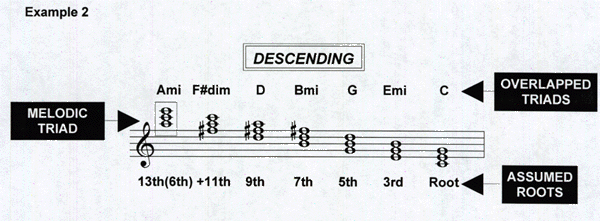
Now each of these added possible triads can be the Root, 3rd or 5th of the Melodic Triad (the triad that the melody functions as the Root, 3rd or 5th). So the harmonization process works two ways - ascending (in which triads are overlapped from the original Melodic Triad) and descending, (in which the Melodic Triad can be considered the overlapped triad built from the 9th, 7th, 5th or 3rd of the real chord (i.e. we can work down to fine the basic triad of the chord that will harmonize the melody. This entire theory and approach is covered in detail in our musicianship course, ‘See It - Hear It / Hear It - Play It’ Parts 1 and 2. In the courses, these are included in the study of Chord Families, Chord Families being all the possible chord forms combined into families of chords that all function the same way in a major or minor tonality. In the study of the nine Chord Families, you learn all of the chords of major or minor key centers, and the overlapping of triads that form the larger chords up to the 13th. It is a neat and concise way to get a real handle on chords, not just as a ‘list’ of chords to file away somewhere, but in real terms of applying them to your playing, songwriting, understanding of harmonic styles of contemporary music, etc. This article is simply trying to describe the premise of the Melodic Triad that can harmonize a melody note or group of melody notes. The actual mastery of the harmonization process will depend on your familiarity with all chord forms, and that is one of the many by-products of our musicianship series. Hope you like this explanation and have some success applying it to your own melodies - Dick Grove | |||||||||||||||||||||||||||



|
READERS! INTRODUCING THE DICK GROVE
CALL (800)994-7683 or Email dana@beyondchops.com NOW TO GET INVOLVED WITH MUSIC NOTES OR JUST DROP US A LINE TO FIND OUT ABOUT ANY OR OUR COURSES | ||||||||||||||

|
We would
appreciate your comments on this and all or our MUSIC NOTES
Electronic Newsletters! Drop us an Email to: Editor |
Enjoy!
Dick Grove and Dana Rasch