
| ||||||||||||||||||||||||||||||
It is now May, 1998 and we have some more articles for you that we hope you will find interesting and helpful! This issue deals with the areas of 'Shortcuts in Notation', and 'Understanding Transposition'. Our goal is to bring you practical ways of looking at areas of contemporary music that can answer questions you have always had in these areas. As usual, we invite you to call or Email if you have questions regarding your understanding of the articles, and it is always great to get your feedback on how you enjoy the newsletter! Call or Email if you have any further questions! Musically - Dick Grove | ||||||||||||||||||||||||||||||
|
| ||||||||||||||||||||||||||||||
|
SHORTCUTS IN NOTATION by Dick Grove The subject of this article can be helpful for you in two ways; in can perhaps help you as a reader, specifically as sightreader, and it can help you is you are a songwriter, arranger, producer or just find it effective to be able to write down your musical ideas - sketching your music! Standard notation rules are one area that music reading requires, so as to standardize how musical instructions are communicated. An area like this has to be standardized or we would have major problems in understanding the intention of the musical instructions. On the other hand, music notations is a fairly large subject, and there are some nooks and crannies that not all readers of music have necessarily been exposed to and use. This is where we are focusing the information in this lesson.
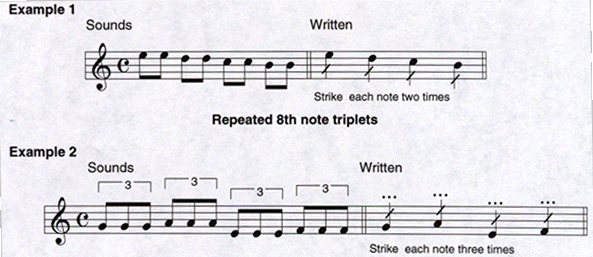
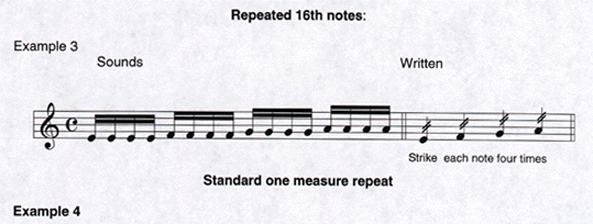
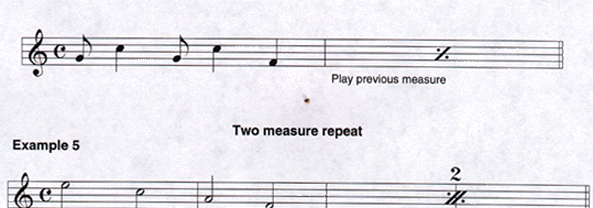
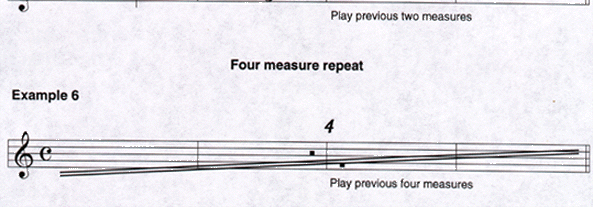
If a beat of music is rhythmically subdivided, and the notes to be repeated are consecutively the same each repeat, then there is a very convenient method used to indicate what to play that saves much time in writing out the instructions.
.
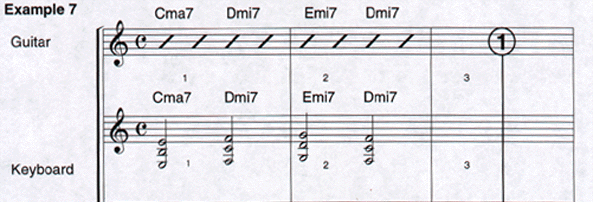
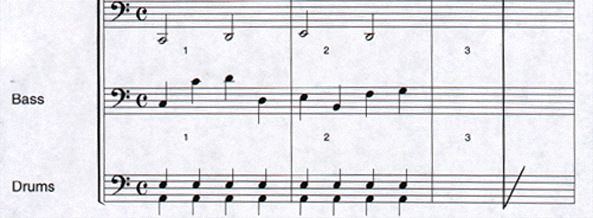
A shortcut called a Coma Sopra is used by arrangers or for sketching music. It allows you to repeat all notes or rests in an entire measure at different points in the music. Normally, the one, two or four measure repeats only apply to consecutive previous measures. This means that the one measure repeat sign instructs you to repeat the last 'written out' measure. The Coma Sopra however, allows you to repeat measure 1 after measure 8, or 88. Portions of a measure cannot be repeated however, but an entire section of music can be written as a Coma Sopra. A typical instance would be where the rhythm section is playing support for a melody. Bars 1 to 8 are the same as bars 9 to 16. If you intended the 2nd 8 bars to be treated and played exactly the same as the first 8 bars, the Coma Sopra could be used in place of literally writing out the contents of each bar again (bar 1 in bar 9, bar 2 in bar IO, bar 3 in bar 1 1, etc.). To do the above situation, you would write the measure number 1 in the staff of measure 9 and place it in a circle. Write the measure number 2 in the staff of measure 1 0, enclosed in a circle, and repeat that approach for as many bars as you desired the same music to be played. If you were writing out the guitar, keyboard (2 staves), bass and drums and wished to repeat what all four instruments were playing, then you would write the circled number, then draw a straight line down through the staves of the other instruments in the rhythm section, ending on the lowest staff with a 'hook' moving upwards to indicate the last stave to be repeated. This shortcut only is used in professional
score and sketches. The Coma Sopra is never written on the player's
parts. It is only an instruction to recopy the music and saves the
arranger or sketcher the time of writing it all out
again.
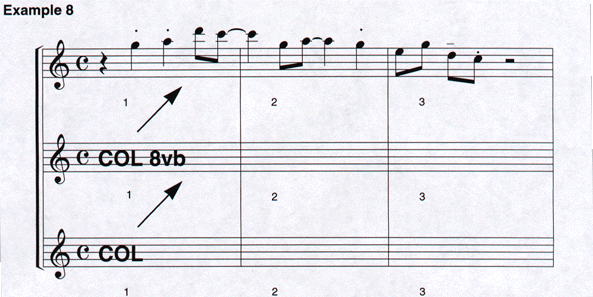
Another devise only used by arrangers and in sketching is a shortcut that instructs the copyist to recopy exactly what is written on another staff of the score for another instrument. The most common situation encountered is when you have more than one instrument playing in unison. This is called 'COL' (which is short for Column). It means to recopy a measure or series of consecutive measures written for another instrument. Example 8 illustrates three trumpets that are intended to play the melody in prime unison an octave below the first trumpet.
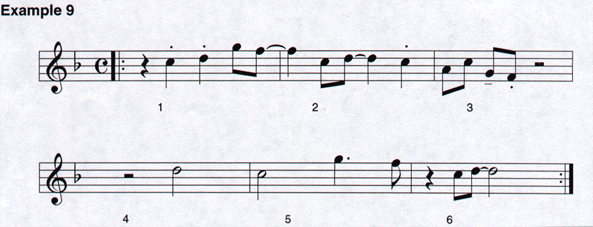
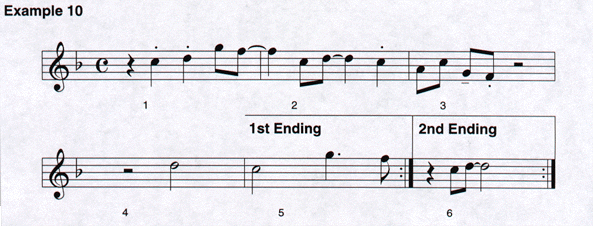
Repeat signs can be varied by using an ending sign. This indicates that you are to repeat the measures enclosed in the repeat signs, up to the point where there is a bracket labeled lst Ending and then 2nd Ending. When the section is to be repeated an indefinite number of times, then the last time is labeled Last Ending (on cue).
At any point in an arrangement, you can have an instruction that tells you to go back to the very first measure and play the first part of the music once more. This is indicated by the sign D.C. This is an abbreviation for Del Capo (which means go to the 'head' or beginning of the music). The D.C. sign is usually followed by CODA, or D.C. al CODA. This now instructs a player to go back to the first measure and play all the music once more up to the point in the music where a coda sign –0- is found. At that point, the player jumps from that point in the music to the coda sign (coda meaning the ending section). A variation of the D.C. sign is the D. S. sign. This means Del Signo or 'go to the sign': The player now jumps to where ever that sign is written, which will be somewhere other than the first notes of the music. D.S. al Coda would mean to jump to the sign, and then play until the coda sign is found, at which point you jump to the Coda section of the arrangement. I hope these examples and explanations will provide you with the ability to work at your music in a more efficient manner and enable you to better enjoy your musical endeavors. Dick Grove | ||||||||||||||||||||||||||||||
|
| ||||||||||||||||||||||||||||||
|
|
 | |||||||||||||||||||||||||||||
| The term Transposition is tricky!
The obvious meaning is to change or transpose music in one tonality
to another. This article will attempt to clear up any misconceptions
you might have about the subject, and suggest some effective ways to
learn to transpose music for yourself. Another idea is using
"Assumed Roots".As discussed previously triads not only work as
chords unto themselves but can be thought of as upper extensions of
larger chord forms.Each interior triad of a larger chord form is
called an Assumed Root.
The reasons we transpose music in one key into another are as follows:
You could be involved in music for years and never have the need to transpose. On the other hand, if intimidated by the process you could also be avoiding the challenge. It is not easy! and demands excellent musicianship to be able to do it, particularly on a spontaneous level.
There are different kinds of musical instruments: brass, saxophones, woodwinds, strings, percussion, keyboards, bass and guitar. Some are made of metal, of wood, of combinations of electronics, metal and wood. Depending on the how an instrument is constructed and played, you will have Wind Instruments (which include the Brass, Saxophones & Woodwinds), String instruments (which include the Violin, Viola, Cello, Double Bass) and acoustic and electronic keyboards and guitars. The construction and tuning of a specific instrument will make it necessary to relate an instrument as being in one or the other of two basic categories - Concert and Transposed. They fall into these groupings:
| ||||||||||||||||||||||||||||||
The bass and guitar are transposing instruments and although sounding in the same key as the concert piano, sound an octave lower than where the notes are written, So they really are transposed, but the key remains the Concert key. In this same fashion, the Piccolo sounds two octaves higher than written. The Viola is written in the Concert key, but is required to be written in the Alto clef instead of the Treble or Bass clefs, and that requires a clef transposition. The Alto Clef is such that the middle line of the stave is Middle 'C'. The reason for using this clef is that the range of the instrument is such that if written in a normal clef, most of the notes would be on ledger lines, making the writing and reading more difficult and demanding. In Alto clef, the majority of notes that fall in the range of the Viola are on the lines and spaces of this clef.
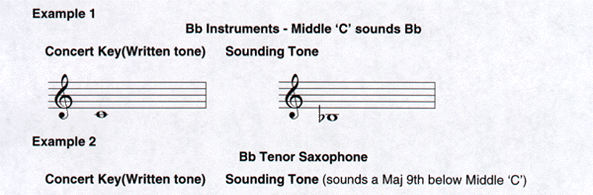
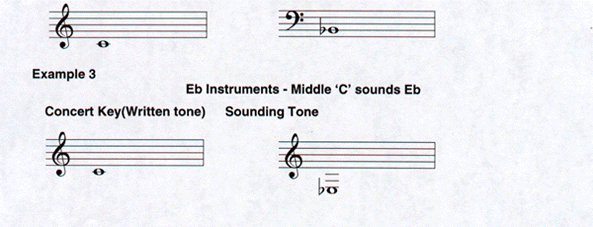
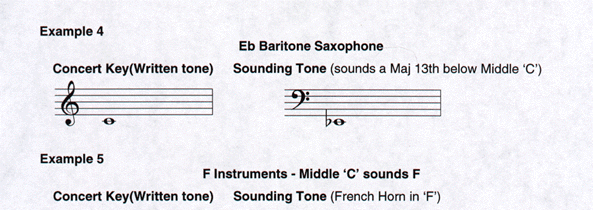
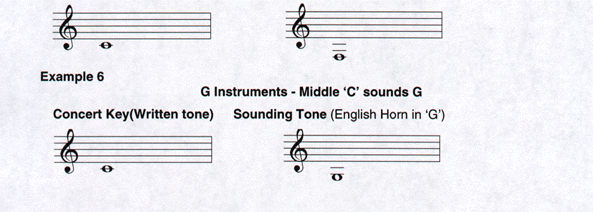
The instruments listed as Bb, Eb, F and G instruments require that the notes be written in a key signature other than the Concert key. The following is an easy and logical way to understand this relationship. Think of the written music showing the tone Middle 'C' in Treble Clef. When one of the instruments in this category reads the tone Middle 'C', it sounds a different note.
The majority of keyboardists and guitars would find themselves transposing keys of songs for singers. There are two aspects to this; first transposing the melody and secondly, the chords. A guitarist would be expected to do one or the other at one time, while a keyboardist could be expected to do both at the same time. If the transposition is from the key of 'C' up or down a whole step or half-step, the change of key is close enough that the player can 'think'the interval in real time, unless the song is quite complicated. If the transposition requires a larger interval however, it becomes much more of a problem to do spontaneously. Most players would solve the problem in one of these ways:
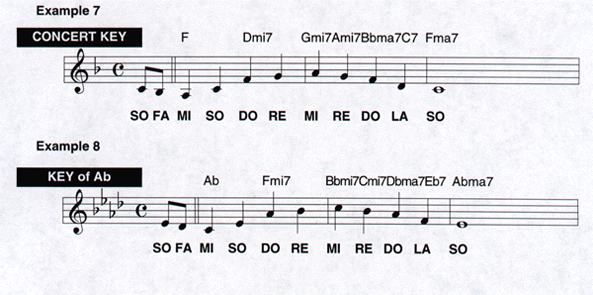
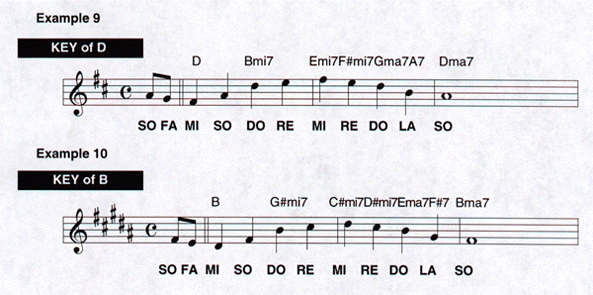
As trying to think the interval each time from note to note is needlessly complicated, the most practical solution for transposing a melody into a different key is to approach the melody as hearing it in solfeg, or if not trained in that technique, by number. If you read my article in the January 1998 issue of MUSIC NOTES you will know I feel the solfeg approach is by far the most effective and comprehensive solution. Numbers will work on completely diatonic melody notes (notes that stay in the major scale of the key signature). One of the by-products of the 'See It - Hear It / Hear It - Play It' courses is that you are conditioned to hear melodies in solfeg and sing what you hear, playing melodies in all keys. The beauty of solfeg is once you know the syllables in solfeg, you know the tune in all keys at once. It really doesn't matter what key you are expected to play it in! One aspect of the solfeg solution is that you are using your ear as you transpose instead of your brain. Your ear can 'hear ahead'- very important when playing in tempo.
Depending on the character and style of the music, chords can be a small or big consideration. In pop music, the chords are basically diatonic, triadic, and relatively easy to hear. When playing standards however, the compositions often change momentary key centers and on occasion, rapidly. That takes a much more mature ear to be able to hear the changes of key. Again, this is part of the 'See It' program training. In this course you are conditioned to hear the changes of key from the melody, which then allows you to hear the chords in each new key center. The following example of transposing a melody illustrates how the solfeg approach simplifies the process and enables you to perform transpositions in real-time, in-tempo conditions.
| ||||||||||||||||||||||||||||||
|
| ||||||||||||||||||||||||||||||
|
ASSIGNMENT Hear are some suggestions on how to work on your own with transposing melodies using these approaches.
Have fun - take a chance! Don't leave the building! Dick Grove | ||||||||||||||||||||||||||||||


|
NEW ISSUE!!!! GROVE/RASCH ANNOUNCES THE AVAILABILITY OF DANA RASCH'S BEGINNING GUITAR BOOK If you are a guitarist who is self-taught, never learned to read music notation and would like to get it together, Dana Rasch's new instruction book on Beginning Guitar is designed to take you from 'square one' and give you a solid foundation in notation applied to the guitar fretboard. You'll learn notation, notes, rhythms, terminology, where the notes are on the fretboard, major scales and how to start developing the ability to sightread music. Best of all, this book will prepare you to get the most out of Dana's Beyond Chops Technique & Improvisation course. It will take you from ground zero right to the first page of the Beyond Chops in a step-by-step teaching approach that really gets results. The book retails for $20.00, and is offered to readers of MUSIC NOTES for an introductory price of $17.50, plus $3.50 S&H (total, $21.00). You can go to our Web Site Order Form and order over the net with a Credit Card number and expiration date, or print out this page and send in the order coupon below. If you have further questions on whether this great book is for you, please call us at (800)994-7683 or Email us at dana@beyondchops.com
IT IS TIME TO GET IT TOGETHER! |
|
We would
appreciate your comments on this and all or our MUSIC NOTES
Electronic Newsletters! Drop us an Email to: Editor |
Enjoy!
Dick Grove and Dana Rasch