 |
A NOTE
FROM DICK
GROVE
|
Welcome to the November issue of MUSIC NOTES. I hope
you have been adding to your collection of articles throughout the
year and are beginning to get a sizable notebook of
information. I also hope that these random topics have helped to
fill in some possible gaps and have helped you.
If you are
relatively new to our newsletter I would like to remind you that all
issues are available to you back to January 1998. Be our
guest!
I would like to report that a growing number of our
students are taking advantage of the college credit units that are
now possible with all our courses. I would like to clarify some
information in this area. Our first level courses, such as ‘See It -
Hear It / Hear It - Play’ Pt 1 ‘Beyond Chops’ Pt1 and Jazz Keyboard
1 are considered undergraduate units.
‘See It - Hear It /
Hear It - Play’ Pt 2, ;Jazz Keyboard’ 2 and all four quarters of the
CAP Composing & Arranging Program are graduate level
units.
Take a good luck at Dana Rasch’s new web site
telling all about his new, 11-week intensive guitar course. The URL
address is: http://www.beyondchops.com/
and Dana can be Emailed at: dana@beyondchops.com Let Dana
tell you all about it as well as explain how it will help your own
individual playing situation. Here is your chance for a
one-on-one conversation with this great player, teacher and
author.
We are happy to also announce, in conjunction to his
opening quarter, that Grove/Rasch Music Education Systems is
sponsoring a drawing for a free, $3,500.00 scholarship to the
February – April 1999 quarter. All of you who attend will never be
the same! You will be receiving a year of education in 11
weeks! An intense environment that will change your
life!
There is still time to take advantage of our
sensational discounts. Check out our End of the Year Newsletter at:
http://www.dickgrove.com/a2b
Here is a timely way to not only get a great discount on
course prices, but you also save off the price increase stating on
January 1, 1999.
Plans are definitely moving ahead for my
new, dedicated improvisation course (for all instruments)
that should be ready somewhere during the first quarter of 1999.
Each segment will include my video lesson, supported with play-along
practice tracks, text and Assignment books (for the key or clef of
your instrument). Now we will have a great course for you horn
players, bassists, woodwind players, singers and your average tuba
player!
Enjoy -
Dick Grove
|
|
STYLES OF CONTEMPORARY
MUSIC
by Dick Grove
As we all gradually develop a greater ability to
express music, either as a player improvising, a composer creating
from scratch, or an arranger organizing and presenting a finished
product, we reach a point where what we play and write becomes more
and more important.
Once we can play or write music, even at
an intermediate level, we start to become interested in styles of
music. This article will try to shed some clarification about
musical styles and try to give you a personal way to relate to
contemporary musical styles.
We deal with music on two
levels, the first having to do with simply how we listen to music,
and the second to do.with our own playing or writing of the music we
personally prefer.
In both instances we need to understand
how to get more out of the music we listen to and learn from, and
certainly how to make greater progress is hearing ideas and
executing them.
To become more effecient and consequently
make faster progress, there is a very effective way to approach the
overall problem, which is to look at our contemporaryh styles from
the standpoint of the harmonic differences between the them.
A great deal of the characteristsics of
contemporary styles has to do with the rhythmic nature of a
particular style, based on the rhytnmic ‘feel’ of the style. Often
the most identifying characteristic of a style is the
rhythm.
Melody uses the stylistic rhythms, added to the
harmonic character to create melodic styles.
An improvisor must
understand the melodic style he or she is working with, otherwise we
would be trying to solve all styles with the same answer and
obviously the result would not sound authentic.
The melodic
character of a style however, is seriously effected by the unique
features of the
harmony. and this aspect is what we will be
looking at today.
In its most fundamental aspect, we can say that
all contemporary styles of music are based on four different styles
of harmony. Try to realize that when we improvise, we must adhere to
the chord progressions of the compoeition. Therefore we are reacting
to what every the harmony tells us. We have to ‘hear’ ideas that fit
the specificis of the progression.
Those styles are;
| a. |
Diatonic II – V – I harmony |
| b. |
Chromatic II – V – I harmony |
| c. |
Blues harmony |
| d. |
Modal harmony |
| e. |
Symmetric
harmony |
|
DIATONIC II - V -
I
HARMONY |
The characteristics of this harmonic style is
to have a completely diatonic major or minor harmonic basis. The
majority of contemporary pop, middle of the road, contemporary
Broadway, New Age and contemporary jazz styles limit the harmonic
possibilities to non-altered chords. This limits the uniqueness of
the melodies and although momentary key centers can change, the
overall impression is rather bland.
This style features
definitive leading tones found in the IImi7 (or IV), V7 and I6 or
ma7 chords
as well as the Plural Substitute chords: the VImi7,
IIImi7, IVma6 or 7 and VII diminished 7th
chord. Improvising
around these definitive tones produce more melodic results.
| CHROMATIC II -
V - I
HARMONY |
Chromatic II – V – I styled compositions now include
altered tones of the major scale combined with diatonic chords. The
melodies are more sophisticated and in general requires a better ear
and mastery of the instrument to improvise and write in this
category. This harmonic style has the most possibilities and
therefore has the most variety from the standpoints of uniqueness of
melody and variation of chord progressions. Traditional Broadway,
standards, jazz, bossanovas, swing and jazz waltzes all utilize this
complicated harmonic style.
We mentioned above how the
definitive leading tones are found in diatonic harmony. Now that the
chromaticism of altered chords are added, there are even more
definitive leading tones as four chromatic leading tones are added
to the two diatonic leading tones. The leading tones predict where
they are going allowing the improvisor to ‘hear ahead’.
The Blues is really unique to American contemporary
music! It spans the Dixieland, ragtime era through swing, be-bop,
Elvis, all contemporary rock groups, disco, rap, and jazz eras. You
could say that the Blues is ‘a state of mind’. In a sense it breaks
all the rules, and makes a believer out of everyone who hears the
music.
The Blues, from a harmonic standpoint, is essentially
a ‘dominant’ sound. This is another way of saying that the
pentatonic and Blues scales are used by all as they contain
non-leading, altered tones of the major scale
Blues can be
played in any meter, any tempo or feel. The Blues impression can be
applied to compositions other than the standard 12-bar blues,
including standards and original compositions with endless thematic
forms.
Modes are completely diatonic harmony and although
diatonic can create interesting colors as when the half-steps of the
major scale are displaced or placed in different scale degree
positions the entire impression changes.
There are two
approaches to modal harmony. The most used and practical is to use
what is called ‘Static Modes’. This implies that a mode (or Modal
scale) is the basis of the harmony and repeats measure after
measure, sometimes for an entire composition or can change after 4,
8 or 16 bars. Instead of thinking chord changes we think
scales, and so improvisation is based more on playing scales as
opposed to chords.
The second approach is based on diatonic
chord changes of the mode in force. There are six modes, each of
which can be thought of as a displacement of the Ionian Mode or
major scale.
They are:
2nd degree: Dorian Mode
3rd degree:
Phyrgian Mode
4th degree: Lydian Mode
5th
degree: Mixolydian Mode
6th degree: Aeolian
Mode
7th degree: Locrian Mode
When melodies are harmonized by diatonic modal chords
they are usually restricted to triads, although larger chord forms
can be used. In most cases, the melody note will function as the
root, 3rd or 5th of a diatonic triad. This approach is typical of
pop ballad styles.
The final harmony category is called Symmetric
Harmony. This is found in fusion music and in the more sophisticated
contemporary compositional styles. It ‘fuses’ together the
characteristics of all harmonic styles and is therefore the most
complicated and unlimited in possibilities.
It takes a better
musician to be able to ‘hear’ and play spontaneously as well as to
play melodically in this area. What makes it so difficult to hear is
that unlike the II – V – I style of music which features leading
tones, symmetric harmony does not ‘lead’ in the same fashion. It is
more a matter of playing from scales again, except they now include
Melodic Minor and Symmetric 8-note scales along with the Major scale
and its Modal displacements. Any tone of a scale can now function as
a leading tone, moving up or down a half-step.
>From a
chord progression standpoint, the roots of the chords also do not
lead, compared to the 5th movement of the IImi7 – V7 – I sequence.
Roots of chords will move in symmetric intervals. Symmetric
intervals means intervals created by taking an octave and dividing
that octave into even divisions (symmetric musically means
equal-distant).
If you take the octave containing 12
half-steps and divide it you will find four possible divisions:
| a. |
Divide in 2 places producing a tritone (6 + 6
halfsteps) |
| b. |
Divide in 3 places producing an augmented
triad (4 + 4 + 4 halfsteps) |
| c. |
Divide in 4 places producing an diminished 7th
chord (3 + 3 + 3 + 3 halfsteps) |
| d. |
Divide in 6 places producing a Whole Tone
scale (2 + 2 + 2 + 2 + 2 + 2
halfsteps) |
When roots of chords move in these non-leading
intervals, the impression of the chord progression is that of
‘floating’ without a strong sense of the basic key center or ‘DO’.
The point of all this information is to see that
first, one needs to be able to identify the differences between
these harmonic characteristics; secondly, realize that all
compositions fall into one or the other of these four categories
(although sections of compositions can change harmonic styles.)
Thirdly, part of your musical training is to be familiar with being
able to hear and be comfortable with any of the categories. Finally,
you should approach listening and creating music from the awareness
of the harmonic style of the moment.
I hope you have found
the above of interest and hopefully that you already have had some
awareness of this organization of harmonic characteristics. Feel
free to call me if you have questions or wish to do more in this
area.
Musically,
Dick Grove |
|
WHAT IS A DOUBLE
ALTERATION?
Chord symbols are a kind of musical shorthand that
tells a musician the structure of harmony within a given key center.
Chord symbols are an approximate representation of a restriction of
tones to use for a number of beats of the pulse of the music. We say
approximate because they are not to be taken literally! A 3-part
triad can be applied as a 5-part form of the chord for
example!
In the August issue of MUSIC NOTES I have an article
about Chord Symbol Terminology. Within
that article we discussed
altered chords and how functions of a chord and be flatted or
sharped.
In some instances, the same tone can be both flatted and
sharped. When this happens it is called a double alteration. If you
had not read the August article, I suggest that you do so in
conjunction with this article.
Here is how it works:
There are only two functions of a chord that can
have a double alteration. The first is the 5th of a chord, and the
other is the 9th of a chord. The 3rd and 7th can not be altered as
these are definitive tones that create the chord form itself. If you
altered the 3rd of a major chord you have made it a minor chord
which is no longer functioning as a major chord in a
tonality.
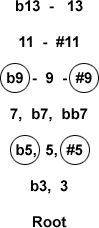
The possible tones of all chords will be some
combination of the following:
Example 1
The 5th of MAJOR CHORDS can both be flatted or
sharped. (written as C(b5), C+ or C(+5,b5)
The 5th of min7th
CHORDS can both be flatted or sharped. (written as Cmi7(b5)
or
Cmi7(#5) or Cmi7(+5,b5)
The 5th of DOMINANT 7th CHORDS can
both be flatted or sharped.
(written as C7(b5), C+7 or C+7( b5
)
The 9th of DOMINANT 7th CHORDS can both be flatted or
sharped.
(written as C7(b9), C7(+9) or C7(+9,b9)
The 5th
and 9th of DOMINANT 7th CHORDS can both be flatted or
sharped.
(written as C+7(b5), C+7(+9,b9) or C+7(+9,b9,b5)
| CHORD
ENHARMONICS, FUNCTIONS &
RESOLUTIONS |
There are some distinctions you should understand
about the precise terminology used to communicate these altered
tones. The b5th of a Cma or dominant 7th chord is the tone Gb.
The enharmonic of Gb is F#. The difference between the two
letternames harmonically is the following:
(1) the b5th
means the 5th of the chord has been replaced by the b5th (the
perfect 5th is not in the chord)
(2) the +11th means that
all the chord tones below the +11th are implied (including the 9th,
7th, 5th, 3rd and root)
The altered I chords function as a I
chord in a major tonality. The alterations add color and create
a
suspended impression, ultimately resolving to the 5th of the
chord or in the case of the +5, moving up
to the 6th.
The
altered dominant chord functions as a V chord in minor, with the
various options of altered tones
creating the possibilities of
from one to four altered tones. The enharmonics all have
harmonic
importance as follows:
| a. |
the b5th of a dominant chord is the enharmonic
of the +11th |
| b. |
the +5 of a dominant chord is the enharmonic of
the b13th |
Like the major chord discussed above, the altered 5th
replaces the perfect 5th of the chord, whereas the upper
extension of the +11th or b13th imply all chord tones below it,
including the perfect 5th.
| HOW
DOUBLE ALTERATIONS ARE
USED |
The alteration of the 5th and 9th allows us to
harmonize melody notes that connect the diatonic tones of a major
scale, without changing chords per note. This attribute also allows
a jazz or fusion improviser to play through scales that contain all
the altered extensions of chords.
From a chord voicing
standpoint, these double alterations are valuable for ‘clustered’
voicing effects that add a great deal of modern sophistication to
the impression. Clusters are chord voicings that organizes tones in
2nds instead of the conventional 3rd intervals that we know from
spelling chords.
| DOUBLE
ALTERATIONS USED AS MELODY
NOTES |
These colorful altered notes are strong, projecting
melodic tones. You will find them used in melodies of standards,
movie themes, jazz compositions and fusion-styled compositions. They
give a composition a great deal of sophistication and sense of
style.
Their biggest contribution however is including them
melodically and harmonically increases the musical possibilities to
be utilized. Melodies are more unique, memorable and varied because
of the options contributed by the addition of these chromatic
tones.
This fact in turn increases the difficulties of
developing your ear to be able to hear chromatic tones and
harmonies. Our See It - Hear It / Hear It - Play It’ Part 2 covers
the eartraining aspects in great depth.
I hope this
information fills in some small 'crevices’ in your foundation, and
more importantly I would wish you to experience the benefits of
including these special sounds into your musical vocabulary and
expression.
Dick Grove
|