 |
A NOTE
FROM DICK
GROVE
|
It is October already and time for some more goodies!
This issue I’ll once more be talking about some subjects you often
hear about but often are not too sure about - so perhaps we can
clear some things up for you.
I would like to thank all of
you that have gotten a copy of my new CD reissue of ‘Big, Bad &
Beautiful’ big band recording.I had my big band for some 14 years in
Los Angeles, and this CD is a good representation of that great band
of players.
We have had a lot of interest in the college
credits that are now possible to earn with the courses,and I hope
anyone interested will feel free to call me about it. There is also
info on the cover page of our web site in the upper left hand
corner.
Dana Rasch will soon have a new web site telling all
about his new, 11-week intensive guitar course. Location, prices,
curriculum, concept and all those good things. Be sure and check our
index on the site for this presentation. Dana will be happy to talk
to you personally about the course and what it will accomplish for
you. It is about the best bargain you will ever find for
moving yourself ahead in one burst of experience!
As you may
know by now, tuition costs are going up a notch January 1,
1999. There is still time to get in on great discounts now before
the prices go into effect. Just give me a call. If ever there was a
time to get that next course or to start a course with us, it is
now. You will get three dollars worth of education for every two you
spend.
I will be able to tell you more about my brand new,
dedicated improvisation course (for all instruments) that should be
ready somewhere during the first quarter of 1999. Each segment will
include my video lesson, supported with play-along practice tracks,
text and Assignment books (for the key or clef of your instrument).
Call me if you are interested!
Many of you are calling to ask
questions or discuss a point you have regarding the articles in this
or other assures. I am also writing an article each month in
Keyboard Magazine which you are welcome to read if you happen to get
your hands on one. You can call me at
(800)994-7683!
Musically -
Dick Grove |
|
HOW TO WRITE A ‘CLEAN’
LEADSHEET
by Dick Grove
One of those little ‘corners’ of being a
musician has to do with leadsheets. A leadsheet is a term
commonly used by musicians to differentiate between a sheet music
and instrumental parts for a band or group.
A lead sheet
usually contains two sources of information: a single note melody
line, and the chord symbols that harmonize the melody. It is not
meant to be an arrangement in the sense that keyboard voicings are
written out, etc. The concept of a leadsheet is to give a player the
basic melodic and harmonic information about a song or composition,
and then the player creates his or her own part, based on that
information.
Lead sheets will show one stave in the treble
clef and as many as 8 or 10 can be placed on a page of music. In
some instances the lyrics are also shown on a lead sheet, written
below the melody with the chord symbols above. This presents a very
clear picture to the musician reading the leadsheet.
‘Fake
books’ usually are made up of collections of lead sheets, but unlike
music folios, there are not the two piano staves with a written
solution to the chords on the staves. A folio in other words, is
just a collection of sheet music arrangements.
Many
musicians, at all levels of proficiency create a personal fake book
of lead sheets on three hole-punched paper. In this they constantly
add songs as they discover them or find the music for songs that
would like to add to their repertoire. This of course assumes you
can read music but being this organized about yourself is one of the
advantages you automatically have when you can read and speak
and relate to music.
| HOW TO LAYOUT
A LEAD
SHEET |
Because of the fact that you can get 32 to 40
measures on one page, many leadsheets will contain a complete song
on one page. This abbreviated form makes for a concise, clear and
basic description of the information about the song. A ‘clean’ lead
sheet follows a certain standardization that includes;
| a. |
four measures on one line (no squeezing as many
as you can on one line) |
| b. |
measure numbers are placed below each measure,
in small print and immediately to the
right of each bar
line. Introductions are normally shown with lower casealphabet
letters
instead of numbers - so that number 1 is measure 1
of the song, not the introduction! |
| c. |
double bars are used to define the thematic form
of the song. This is usually in 8-bar segments. (double bars
therefore occur at the end of bar 8, 16, 24 and 32 and at the
beginning of bars 9, 17 and 25 |
| d. |
chord symbols for the most part, are written
over the primary beats of a measure, in 4.4
this would mean
over the 1st and 3rd beats. |
| e. |
lyrics, if to be included, are printed (not
written) below each melody note and will include
lines to
denote when a syllable is held over a change of pitch, or a
sustained tone |
| f. |
when printing the lyrics it is a good idea to
use a ruler as a lower base line for your pen or
pencil to
insure uniformity of the size of the letters and that the base
line of the letters are
even |
| g. |
1st and 2nd endings are used in a normal
fashion, but care should be takento make
everything fit
and not ‘run into each other or on top of each other’. |
| h. |
repeat signs are used in a normal way. |
| i. |
the rhythms used with the melodic tones can be
relatively simple and moreoriented for vocal use than
instrumental. The player now will interpret the melodic
rhythms in their own way, and personalize it for his or her
instrument, tempo and setting. Again, a lead
sheet is not
designed to be an arrangement! |
| j. |
Make sure that if the song you are doing has a
melody that starts with pickups, that the
double bar,
repeat sign, etc., comes after the pickups and defines
measure 1. The pickups are before the double bar, or in the
last measure of the introduction. |
| k. |
Rehearsal letters may be added every 8 or 16
measures. These serve as reference points
when rehearsing
and practicing the song. They are faster and easier to notice
than the small measure numbers and represent the logical
places to start from when rehearsing. |
|
|
|
|
The point of being able to write a nice, ‘clean’
leadsheet is that first of all, it is easy to read. Secondly, it is
as accurate a representation of the song as possible and should
contain the correct melody tones, and good definitive chord symbols.
A well written lead sheet tells anyone who sees that music
that the person who wrote it out is neat, a good musician who knows
what he is doing and cares about what people think of this or her
work. You make impressions on people and it obviously is better go
make good impressions than bad ones.
It is permissible to use
legit shortcuts like chord inversions (C/E) and polychord. (Both of
these
chord symbol variations were discussed in the August
edition of MUSIC NOTES.)
|
COMPUTER GENERATED
LEADSHEETS
(the easy way
out?) |
This day and age most of us have a computer,
and if you are a musician, some level of music writing application.
From Finale on down even the most basic music writing program can
generate a lead sheet for you. However, you still have to make
decisions and so from that standpoint we are covering aspects that
will help you let the computer do some of the work for you (but it
doesn’t do all the thinking).
If you are making a lead sheet
on your computer, here is a working procedure to use to get the most
efficient results in the best time.
| a. |
count the measures of the song you wish to
make a leadsheet for, including any intro
and ending, or
tag, second chorus, etc. The entire measure count of the music
to be!
Now divide that number by 4, and you will know how
many lines you will need to complete the lead sheet, and how
many pages it will take to print it out. |
| b. |
determine if you are going to include lyrics.
If so, it is a good idea to allow more room
between staves.
If you would have multiple lines of lyrics (two versions, each
with their
own lyric), then give yourself even more space
between staves |
| c. |
put in your song title, composer/lyricist,
perhaps copyright info. This normally is at the top of the
first page in larger type (anywhere from 14pt to 36pt). |
| d. |
now add your measure numbers. Use whatever
options your application allows you to use to determine the
placement of the measure numbers in relation to the stave and
bar lines. If you are not able to use lower case alphabet
letters and then change to
numbers, start your numbers on
measure 1of the song, and put nothing in for
the
introduction. When the music is all printed out, come
back and write in the alphabet numbers for the intro. |
| e. |
anytime you can not get your application to
place the needed words, symbols, directions, whatever, print
out what does work, and write in the needed
instructions. |
| f. |
Place all repeat signs, double bars, 1st and
2nd endings, coda signs, etc.where they are to be
positioned. |
| g. |
Now start laying in your melody. If you put
melody notes in step fashion, you may be able to copy and
paste any repeated segments of the melody. Just make
sure the
melody is exactly the same - close isn’t good
enough. |
| h. |
if there are lyrics, add them now. They will
determine the final spacing
of the melody and bar
lines. |
| i. |
now add chord symbols |
| j. |
add any instructions as to the tempo, coda, DS
or DC, 1st and 2nd endings,etc. |
| k. |
print out a copy of your leadsheet, and now
write in any words or symbols that you were not able to get
with your music application |
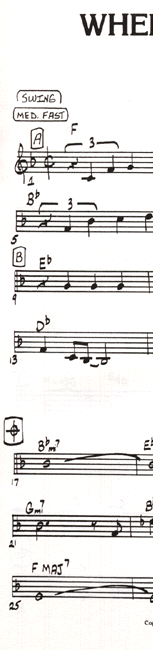
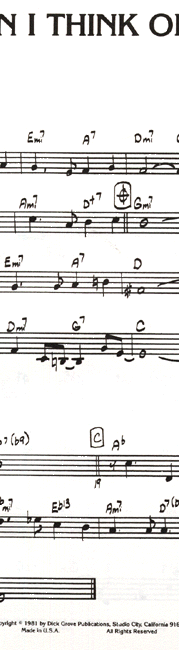
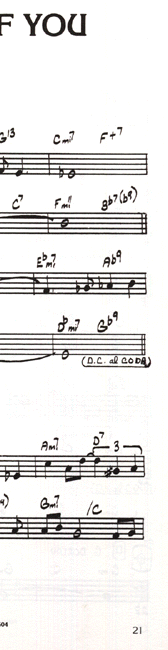
You can now examine the following leadsheet
and check it out against the points mentioned in this lesson. There
is a reason and purpose for doing everything the way it is done,
with the end result as shown in this example. When you do your own
leadsheets you will now have a working procedure and a concept of
what it should look like when finished.
“WHEN I THINK OF YOU”
Composed by Dick Grove
- © 1981 - Dick Grove Publications
| TO DO IT YOU
NEED TO DO
IT!!! |
Like most things, after you have gone through the
procedure a few times you know what to do and when to do it. In
building your own fakebook for instance, you will have the ideal
reason to become adept and reasonably fast at creating leadsheets,
either the old-fashioned by hand way, or with your computer.
It is always nice to know how to do it without a computer
because situations arise where there is no computer to use, and so
you do it yourself.
Hope all of this is a help - if you have
never tired to write a lead sheet., run with the idea of
building your own collection of favorite songs and just add to it
from time to time. It is a great idea, organizes you and gives you a
permanent resource for being a better player!
Till next month
-
Dick Grove
|
We would
appreciate your comments on this and all or our MUSIC NOTES
Electronic Newsletters! Drop us an Email to: Editor MUSIC
NOTES |
Enjoy!
Dick Grove and Dana Rasch |