|

|
|
|

|
|
GROVE /
RASCH MUSIC EDUCATION SYSTEMS ELECTRONIC
NEWSLETTER
No. 9 - September 15th
1998 | |
 |
A NOTE
FROM DICK
GROVE
|
Our September issue is a very important one for us. We
are announcing many new and important developments with the Dick
Grove ‘School Without Walls’. I hope you take the time to read the
complete issue and we would be happy to discuss any aspects you
would like to call us about. The articles this month include another
good one from Dana Rasch, his Part 2 on the Dominant Pentatonic
Series. My articles include a discussion on the importance of
developing your ear as the critical step in becoming a better
performer and creative musician and some short cuts to learning
chord extensions!
In August we announced my new CD reissue
of ‘Big, Bad & Beautiful’ big band recording. Many of you have
ordered it and I hope you will like to obtain a copy This month we
are very proud to announce that it will now be possible to earn
college credit through the ‘School Without Walls’. This will apply
to those of you who have already completed courses, or are currently
working on a course, or who plan to enroll and would like to receive
college credit for your efforts. There is an extra per unit charge
for this benefit, so you should call me for details if you are
interested in considering get credits through us.
As of
January 1, 1999, there will be a price increase on all of our
courses, so it behooves you to consider starting courses before the
price change. We are sending special flyers and Emails to our entire
mailing list with details on all of the above, but particularly,
there will be a sensational 1/3 off offer for a limited time only.
Check your Email from us!
I will also be coming out
with a brand new, dedicated improvisation course (for all
instruments) Each segment will include my video lesson, supported
with play-along practice tracks, text and Assignment books (for the
key or clef of your instrument). Call me if you are
interested!
Again, we invite you if you have questions
regarding the articles this issue
to call me at
(800)994-7683!
Musically -
Dick Grove |
|

|
|
THE IMPORTANCE OF
MUSICIANSHIP
by Dick Grove
I’m a lucky duck! My career in music has allowed me to do just
what I have wanted to do, the way I wanted to do it! Not a bad
goal - I think you would agree! As a keyboardist, arranger,
composer, orchestrator, conductor, author, publisher, teacher and
friend to thousands of musicians and students I have been in a
position to get a very objective and comprehensive point of view
about how we all pursue our emotional musical goals.
You
can’t have this kind of experience without seeing a pattern and
common denominator to the ‘process’ of each of us finding a
direction in music and then working towards our potential. One’s
evolution as a creative performer / composer / arranger / singer /
songwriter is a process in which we travel to a goal, driven by many
things. Love of music, greed, total absorption, the pleasure of
doing ‘our’ thing, relaxing from the pressures of today, finding out
how good we can be, finding our ‘voice’ as a creative artist, etc.,
etc., etc.
I can also state unequivately, that everyone has
a different story! We all have a different history of our musical
experiences, opportunities, talent, environment and time frames. It
is this constantly contrasting equation that attracts and
energizes my work with all of you in the School Without Walls.
Most musicians I come in contact with are trying to improve
themselves, by themselves. It is a very difficult challenge to do on
your own. It is very much like going somewhere without a map! Being
your own teacher usually means taking whatever information you
happen to ‘bump’ into and trying to absorb and learn from those
sources. You might read ‘how to’ articles in music magazines, take a
lesson once in a while, buy a book or instructional video, jam with
friends, listen to CD’s, sit down and ‘discover’ things, etc. You
can end up with a room full of books, videos, lesson notes, lead
sheets, music folios and a head full of frustrated feelings! The
problem of course with this unorganized approach is:
| a. |
nothing connects to the next thing – there is
no underlying ‘logic’ |
| b. |
you are not starting where you need to start
to ‘see the picture’ You are ‘swiss cheese’ |
| c. |
when you get stumped you have no where to go
to get answers |
| d. |
years go by and you find yourself if not in a
rut, nowhere near where you think you should be by this time
|
| e. |
you start to get discouraged and find yourself
not getting the pleasure out of your music (that was the whole
point you were after when you started! – remember?) |
| f. |
you are playing music more from a ‘finger’ and
brain approach than with your ear. We all create ‘comfort
zones’ and operate from these to solve our musical problems.
The more limited you are in this area the more you limit your
playing abilities |
|
AN EAR IS AN EAR IS AN
EAR
(THOSE THINGS ON THE SIDE OF YOUR
HEAD) |
Your biggest asset (whether you know it or not) is your ear. Now
we all have an ear, but it needs to be an ‘educated ear’ that can
hear what it sees, and knows what it is hearing. It takes a period
of conditioning to be able to develop this more musical way of using
your ear.
Approaching eartraining as an isolated subject
usually doesn’t work well in a practical sense. We make our music in
a context of playing spontaneously so unless the eartraining
experience is linked to Modern Harmony and you can relate
eartraining to melody, harmony and rhythm, you are not really able
to apply this ability in a real way! We are after developing a good
‘relative pitch’. Perfect pitch is a condition that you are either
born with or not. Having Perfect pitch however, doesn’t mean you
know what notes to play or write. One of my interested students once
said to me “well, I don’t think I need to start at the beginning
because I have Perfect pitch”. I answered “ well that’s great - but
tell me, what is it you would like to accomplish?” He said “ I would
like to learn how to improvise!” My reply was “well if you have
Perfect pitch, why can’t you improvise?” So you see, being able to
identify a note that you hear doesn’t tell you what note to play! –
it is an entirely different matter.
We all need to become
well grounded musicians with a solid foundation. This means that you
need to understand how melody and harmony really work, how to hear
them in context to moving phrases and chord progressions, relative
to the different contemporary styles we deal with in this day and
age. Once you understand the foundation, you have a real way of
dealing with all styles, from Dixieland jazz to fusion! Once you
have the answers, then you can ask any question and be able to
relate to the goal you are after!
You will find that even
attending a local college or university will not give you that
practical foundation you need. Most all of the school curriculums
are based on the European approach to music and even though you will
get information and details of that information, it has little if
anything to do with playing on a bandstand or writing a contemporary
song that is memorable!
Our courses and the School Without
Walls in general, represent an alternative to going to a
professional music school. Our courses get right down to it, they
cost you a fraction of the cost of a college, and you can do it at
your own pace and continue your job, life and family commitments all
at the same time! It is called having your cake and eating it too!
If you check out our Educational Tree on the web site you will see
how all our courses link to each other and will take you as far as
you would like to go.
Once your ear is working right, you
will find that the process of growing as a musician is ten times
faster and easier. This is another way of saying that until your ear
does work well, you are compromising yourself without realizing it!
What our courses do are actually explain and show you how to focus
your ear so that you can hear those musical aspects you need to
hear.
In the process you learn how progressions really work, how
to create good melodies, and have a realistic way to relate to the
melodic, harmonic and rhythmic characteristics of our different
musical styles.
|
WHAT
EXACTLY IS
MUSICIANSHIP |
Musicianship is one of those words that can mean
something different to everyone you ask! It is an ‘umbrella’ term
that includes all of the following (here is a short list):
| 1 |
Really knowing all basics of musical notation
including clefs, key signatures, accidentals,
terminology |
| 2 |
Spontaneously recognizing notes of
melodies |
| 3 |
Knowing what you hear in your head |
| 4 |
Being able to ‘hear’ chord progressions
without playing them first |
| 5 |
Being able to hear harmonic modulations from
one key to another |
| 6 |
Hearing altered chords and chromatic
harmony |
| 7 |
Knowing ALL chord forms of chords in major and
minor |
| 8 |
Being able to write down in musical notation,
rhythms, melodies and harmonies |
| 9 |
Understanding all chord voicings and having
the ability to hear them before playing them |
| 10 |
Basic understanding of harmonizing
melodies |
| 11 |
Analyzing chords f rom written notes |
| 12 |
Hearing ‘target notes’ to get better melodic
improvising |
| 13 |
Better understanding of contemporary styles
rhythmically, melodically and harmonically |
| 14 |
Understanding the natural logic of
music |
Even though you can spend a life time working with your
music, it is important to realize that just ‘doing’ exercises is not
what it is all about, if fact just playing your instrument is not
what its is all about. There are great concert pianists that once
you take the music away, cannot spontaneously create music and they
have spent a lifetime playing their instrument! You can spend years
working at your music, assuming that what you are working on will
solve your problems, only to find out down the road that you still
cannot get to your potential!
There is a basic logic that
takes the infinite possibilities of music and condenses them into a
handful of basic premises from which everything is taken. Once your
brain understands these concepts and your ear is trained to hear
these underlying aspects of melody, harmony and rhythm, your
learning experiences will never be the same. Learning from the
‘core’ of the music makes the entire process ten times faster and
easier. This is why being involved with the School Without Walls
gets such dramatic results. It is what and how you are taught that
gets immediate results, enabling you to grow and have the capacity
to evolve from one level to the next for your entire life!
Studying music is supposed to make your participation
easier. It should not be a matter of simply talking about aspects of
music and then expecting the student to figure out how to learn,
absorb and apply the techniques for themselves. That should all be
figured out by the teacher, then under his guidance you personalize
and absorb the information. This basic logic reveals how music works
in a straight, connected line, wherein each aspect logically is
connected to the last premise and you end up with a solid
understanding that your ear recognizes, your brain knows, and with
which your musical ‘operating system’ can help you create your own
music with authority and confidence.
The Grove School of
Music, which I founded in Los Angeles in 1973 and led for almost 20
years, was known all over the world for turning out superior
graduates that could compete in the business of music and who could
make their own musical statements. We did it in one or two years of
intensive study. Basically we offered them more in two years than
they could receive in 4 or 5 years at a college or university,
plus what they learned they could from our programs they could
apply!
You could say that learning these basic premises is
the key to solid musicianship and faster development. You could have
a doctorate in music and never have it explained to you. If you go
down a road step by step, you can enjoy the trip and go farther than
you ever imagined! It is the great musician who makes the great
music - no matter what the style or context - it always holds
true!
Your musical goals, modest or top level, can be
accomplished better and faster by first getting your foundation of
musicianship together. Then the application of that musicianship is
much more rewarding when we show you how to apply that foundation to
your playing, writing or teaching goals. The best part is that the
longer you do it this way, the farther you can take it and more
creative you will become - age is not relative, so whether you are
16 or 76, you will experience the difference.
You are more than welcome to call me at
(800)994-7683 or Email me at dana@beyondchops.com and I can
show you how this concept can change things for you! Till then -
think about all of this and what you have been doing the past year
or more. Any frustrations you have had with being in a rut, taking
lessons and not getting what you need, going to a college where they
don’t understand the problem, or realizing that you can never take a
year and $25,000.00 to try to get your education, can all be
resolved once you get on the ‘road’ to getting it together.
We pull things together for people - all it takes is desire
and some discipline. Our courses are so structured that even if you
are so busy you can only do a handful of hours a week, you will
still get great results and quality progress because of being in an
organized plan. Our one-on-one support is your safety net. We can
customize your course to fit any weird angle you have, and remember
- I have a lot of experience and have dealt with every conceivable
situation you might throw at me before. Take advantage of that
experience and commitment I have and get a coach on your team that
actually wants to spend some time with you - listening to where you
are coming from and to where you want to go.
Remember, the
point here is to feel good about our music and ourselves making
music. You are going to be able to experience those good feelings
once you make yourself a plan, with our help, and just get started.
The worst that can happen is that you might have to hock your
instrument - but with good musicianship all is not lost - you can
still hear it all in your head!
Hope you find this
interesting and relate it to where you feel you are!
Dick
Grove
|
|
|
|
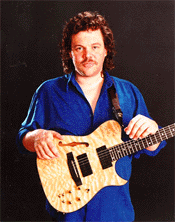
DOMINANT PENTATONIC SERIES PART
2
by Dana Rasch |
 |
Assuming that you are now
familiar with the 5 shapes of Dominant Pentatonic and have tried
applying it over the min7 chord or pedal bass idea given in Part 1
of MUSIC NOTES, lets take a look at some other ideas.
One
important concept is becoming proficient at playing Dominant
Pentatonic in all keys and in any one area of the neck!!!
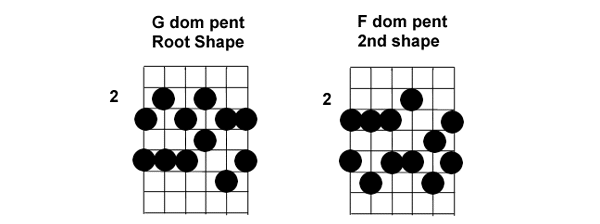
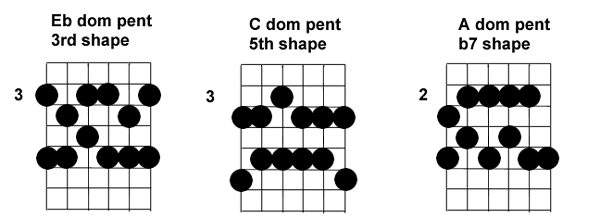
If
we wanted to play G Dom. Pent. Root shape we obviously would start
on the note “G”. We could also play 4 other Dom. Pent. scales in the
keys of F, Eb, C, and A without jumping around the neck and still
starting on the note “G”. In other words 5 keys with one starting
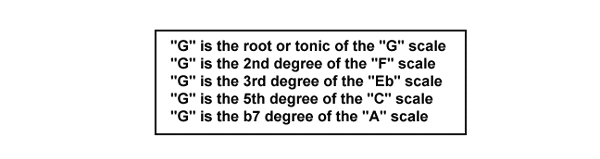
tone. In Example 1 we see an application of ‘plurality’ in music.
Plurality means that a tone or chord can have a multiple function.
In this sense then, the tone “G” can be thought of in all the
following ways:
Try playing up and back in each key seperately until you feel
familiar with all 5 keys, then try going up in one key and come back
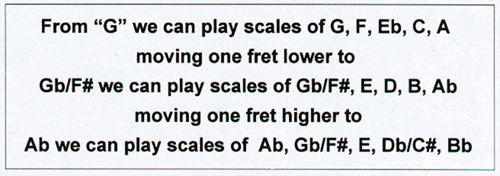
down in another. We see now that we can play in 5 keys starting off
of the same one note. By moving 1 fret higher or one fret lower we
will be able to play in 10 more keys (5 keys by moving 1 fret higher
and an additional 5 keys by moving 1 fret lower). This means we can
play in 15 different keys without moving more than 1 fret in either
direction.
This idea is called minimal movement and has a tendency to
help you create more melodic ideas as opposed to jumping all over
the neck.
In all styles of music we can find a common
progression called the Harmonic Circle of 5th’s. The II V I
progression (Dmin7 G7 Cmaj7)for example moves in the Harmonic Circle
of 5th’s.
A way to start developing your abilities with
Dominant Pentatonic is to think of playing over Dom 9th chords
moving in the circle of 5ths. (C9, F9, Bb9, Eb9,
etc.)
As we have discussed before, the Dominant Pentatonic
scale is a horizontal form of a 9th chord
| C, |
D, |
E, |
G, |
Bb, |
| 1, |
2,(9) |
3, |
5, |
b7 | |
Try laying this progression down on tape at a slow tempo or
faster tempos with each chord receiving more bars (either 2 of 4
bars per chord)
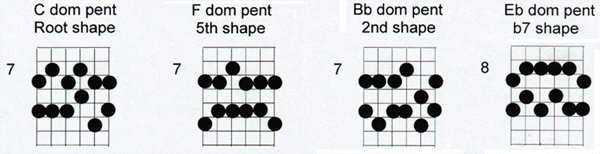
Using the concept of minimal movement as discussed
above, play over the following 5 chords starting with "C" as your
root
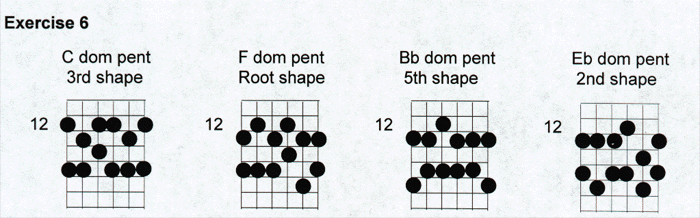
Exercise
1
In the case of the first 3 chords we were able to find
the Dom. Pent.scale needed, starting on the note “C”. “C” is the
root of”C, the 5th of “F” and the 2nd of ‘Bb”. When moving to the
last chord we moved up a half step to “Db.” (“Db” is b7 of “Eb”)
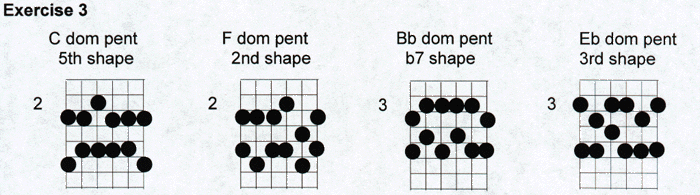
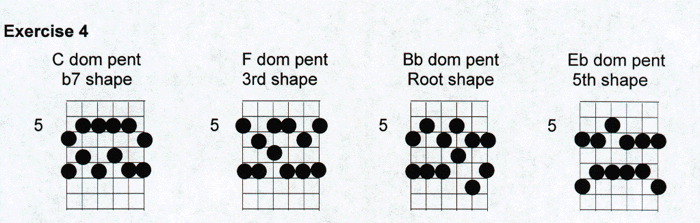
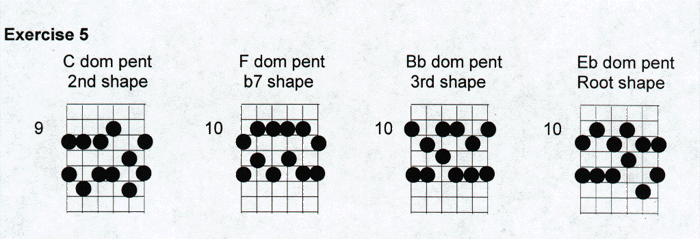
After you feel comfortable with Exercise 2 practice starting
with the other 4 shapes of “C” Dom. Pent. as shown in
Exercises 3 through 6.
|
|
|
CHORD
EXTENSIONS
By Dick
Grove |
| .
Chords are the use of multiple scale degrees, organized
vertically. Here is a basic way to think of them. Chord symbols are
only a ‘code’ to represent tones that create impressions of harmony
as being either ‘resting’ in character (requiring no further
movement or resolution, or ‘active’ in character (requiring the
resolution to a following chord of a chord progression.
The
source of the tones in a chord are the 7 or 8 notes of a
scale. The melody of a song represents the same scale horizontally,
and the supportive harmony comes from the same scale organized
vertically. Utilizing the same scale is what allows the harmony to
fit the melody. If all the tones of a scale are possible melody
notes, then when the chords are created by using the scale source
vertically it stands to reason that we have to account for all the
tones in the scale course.
To accomplish this, we choose
scale tones basically in 3rds (taking every other tone of the
scale), and by measuring the distance from each note of the scale
source to the tonic of the scale, we arrive at the Root, 3rd, 5th,
7th, 9th, 1th and 13th. Each of these function now have to be
qualified as a:
| 1 |
major or minor 3rd |
| 2 |
Perfect, Augmented or Diminished 5th |
| 3 |
major or minor 7th |
| 4 |
major, minor or augmented 9th |
| 5 |
Perfect or augmented 11th |
| 6 |
major or minor
13th |
Starting with the basic major, minor, augmented and diminished
triads and continuing through the 7ths, 9ths, 11ths and 13ths, every
musician will learn a given amount of these chord forms in most
keys. The most popular keys will come first, and then the less used
key centers complete the required vocabulary of chords. With all of
these possibilities, they can be divided however into two main
categories: BASIC CHORD FORMS and the CHORD EXTENSIONS. This simply
means the higher chord functions of the 9th, 11th and 13 are
considered ‘extending’ the chord into the tone a greater distance
from the root of the chord. It also follows that the high chord
extensions are more difficult to learn, particularly in the more
difficult keys.
Much of our contemporary music is harmonically simple, meaning
that the melodic tones of these compositions are almost entirely
based on the first four tones of a chord (Root, 3rd, 5th and 7th).
The result of this restriction that you notice when listening to
this music, is that there is little tension in the melody and there
is a stylistic lack of color or chromaticism in these songs. We are
talking about Rock, HipHop, Funk, Rhythm & Blues, Country, Pop,
Reggae, Rap, etc.
Styles of jazz, fusion and more progression
contemporary music utilize not only the extensions of chords but
altered extensions (as listed above). For any of you interested in
getting a better handle on knowing all the chords in the larger
forms, read on!
| LEARNING CHORD EXTENSIONS IN ALL
KEYS |
The purpose of this article is to give you a short cut to
learning your chord extensions in all keys, with the goal that you
can visualize and name the extensions rapidly. This will also help
you in hearing melody tones that are high extensions in songs. If
you are into understanding jazz better, it is important to know all
your chords, through the 13ths, and in altered as well as diatonic
forms. In the natural construction of chords, the high extension
tones (9th, 11th, 13th) are presented in order, with generally a
major or minor third between each. The least effective way to relate
to these tones is by counting up from the root each time you wish to
find a specific tone. In fact, if we only look at the extensions, we
can see them as a self-contained triad built from the tone a whole
step above the root of a chord! This presents an easy to visualize
simple triad which then can be thought of as the upper extensions of
a chord.
The following examples will give you an
illustration of this upper extension triad in relationship to all
chord types (resting and active/diatonic and altered) of
contemporary music.
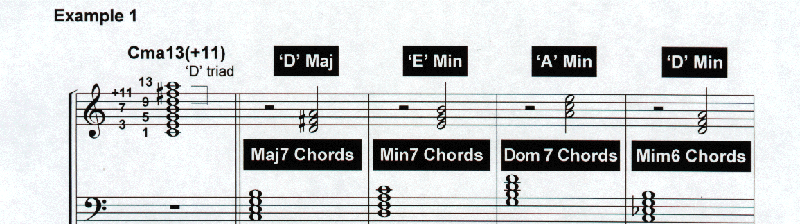
Example: Major 13th(+11) chord stack / D major triad shape
built from 9th / Chord Functions
| Meas 1: |
I chord in Major ('D’ major triad functions as
9th, #11th and 13th) |
| Meas 2: |
IImi7 chord in Major ('E’ minor triad
functions as 9th, 11th and 13th |
| Meas 3: |
V7 chord in Major ('A’ minor triad functions
as 9th, 11th and 13th |
| Meas 4: |
I chord in Minor ('D’ minor triad functions as
9th, 11th and 13th) |
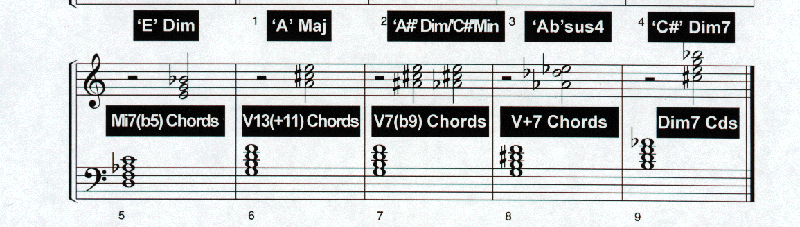
| Meas 5: |
IImi7(b5) chord in Minor ('D’ minor triad
functions as 9th, 11th and 13th |
| Meas 6: |
V13(+11) chord in Minor ('A’ Major triad
functions as 9th, +11th and 13th |
| Meas 7: |
V13(+11,+9,b9)chord in Minor ('A#’ dim triad
functions as #9th, #11th and
13th)
('C#’ dim triad/5 functions as b9th, #11th and 13th) |
| Meas 8: |
V+7(b13,+11,+9,b9)chord in Minor ('Ab’ sus 4
triad functions as b9th, #11th and b13th) |
| Meas 9: |
VII dim 7th chord in Minor ('C#’ dim 7th
functions as 9th, 11th ,b13th and
15th) |
| SUGGESTED PRACTICE
ROUTINES |
Using Example 1 as a model, you can work out with this ‘short
cut’ to learn your high tension extensions in all keys. I would
suggest that you work with these solutions in the following
ways:
| 1 |
Play measure one by playing the Root, 3rd, 5th
and 7th in your left hand on a keyboard, then play the triad
built from the 9th of the chord in the right hand. Follow the
example when you do this by playing the lower chord functions
in the left hand first, and while holding these notes, play
the extensions in your right hand. Now sustain both hands and
listen to the sound of the total chord. Some of these will
sound dissonant
when played in this fashion, but don’t let
that throw you. |
| 2 |
Now play the same formula in all keys, moving
in this order of chords built from these roots: |
| C
F Bb Eb Ab Db
Gb(F#) B E
A D G |
| 3 |
Follow the same procedure with measure 2,
moving through all keys. |
| 4 |
Continue through to measure 9. Your goal is to
be able to visualize these extensions in your ‘minds eye’
by grasping the familiar triad from the tone a whole
step above the root |
| 5 |
As each chord type has a different formula of
upper extension triad, you will find that it is the repetition
of practicing this exercise that will ingrain the specific
answers in your mind. |
| 6 |
In measure 7, we have a situation wherein the
chord contains a double alteration of the 9th of the chord. As
this relationship is a whole step (from the b9th to the #9th)
the triad ‘look’ can best be seen by using two answers, one
containing the b9th and the other triad shape containing the
#9th. |
| 7 |
The more altered chords shown in measure 8 do
not conform to simple triad shapes. For instance
in measure 8, you could think of this combination as an
Ab(sus4) chord symbol. In measure 9, the diminished 7th chord
has a scale source of an 8-note symmetric scale, therefore the
upper structure has four tones rather than only three, and
forms another diminished 7th chord built from the tone a whole
step above the root. |
Good luck with your extensions and your wisdom teeth - see
you next month!
Dick Grove
|
|
We would
appreciate your comments on this and all or our MUSIC NOTES
Electronic Newsletters! Drop us an Email to: Editor MUSIC
NOTES |
Enjoy!
Dick Grove and Dana Rasch |